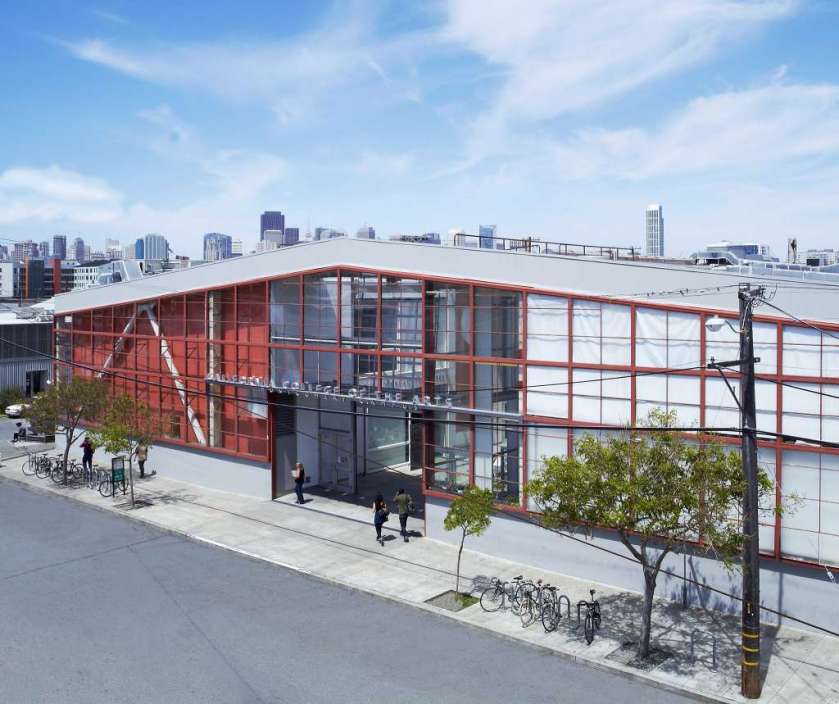
Photo source: Daniel Gonzalez blog
Apply here for Associate Provost for Faculty and Academic Partnerships, or go to:
https://cca.wd5.myworkdayjobs.com/en-US/CCA/job/Oakland/Associate-Provost_R502291-1

Photo source: Daniel Gonzalez blog
Apply here for Associate Provost for Faculty and Academic Partnerships, or go to:
https://cca.wd5.myworkdayjobs.com/en-US/CCA/job/Oakland/Associate-Provost_R502291-1
The Department of Art History at the University of Chicago seeks (an) art or architectural historian(s) of the Black Atlantic, specializing in any pertinent historical period and in any territory of Africa, Latin America, the Caribbean, North America, Iberia, and/or the more ramified Atlantic world. We are also interested in art or architectural historians working more broadly on race, (post)colonialism, and visual culture in the Atlantic world. The ability to work across fields and subfields is highly desirable, as we expect the successful candidate to collaborate with faculty within and beyond our department.
The Department of Art History values diversity. A goal of the search is to increase the diversity of the faculty in the Department of Art History and across the Humanities Division, and we therefore welcome applicants from groups historically underrepresented in academia, such as black/African American, Hispanic/Latino, American Indian or Alaskan Native.
Successful candidates will be appointed either as a tenure-track Assistant Professor, or as a Provost Fellow at the rank of Instructor with an initial two-year faculty appointment. This initial period is intended to serve in lieu of a postdoctoral appointment. Provost Fellows will teach one class/year, receive research support, and participate in programming designed to help support them in their transition to Assistant Professor. Provost Fellows will ordinarily be promoted to Assistant Professor at the end of their 2-year term. Candidates for Provost Fellow appointment must have no more than two years of postdoctoral experience. All candidates must have the Ph.D. in hand by the start of the appointment, 1 July 2018.
Complete application materials include cover letter (including discussion of research and teaching interests), CV, two scholarly writing samples, names and contact information for three professional references, and a statement describing the applicant’s prior and potential contributions to diversity in the context of academic research, teaching, and service. Applicants should send all materials in electronic format (MS Word or PDF) to Caroline Altekruse at caltekruse@uchicago.edu with subject heading “Black Atlantic Art and Architecture Search.” In addition, applicants must upload the CV and cover letter to the Academic Career Opportunities website at http://tinyurl.com/ya6e3sek. No applications received after 20 September 2017 will be accepted. University positions are contingent upon budgetary approval.
The University of Chicago is an Affirmative Action/Equal Opportunity/Disabled/Veterans Employer and does not discriminate on the basis of race, color, religion, sex, sexual orientation, gender identity, national or ethnic origin, age, status as an individual with a disability, protected veteran status, genetic information, or other protected classes under the law. For additional information please see the University’s Notice of Nondiscrimination at http://www.uchicago.edu/about/non_discrimination_statement/. Job seekers in need of a reasonable accommodation to complete the application process should call 773-702-0287 or email ACOppAdministrator@uchicago.edu with their request.
Alternative Visions: The Photograph, Self-Representation, and Fact in Contemporary Art of the United States
|
||||
|
||||
Augustus Washington (1820/21-1875) was “the son of a South Asian immigrant” a formally enslaved black Virginian, according to this article published in The Dartmouth Alumni Magazine this spring. Washington studied at Dartmouth, entering with the class of 1847. There, on the Hanover, New Hampshire campus, Washington learned how to make daguerreotypes. Washington and Dempsey R. Fletcher were the only students of African descent at Dartmouth in 1843-44.
Washington’s portrait of John Brown (circa 1846-47) is well-known. Yet there are no confirmed images of Washington himself. Photo historians have been searching and writing about Washington for decades, and the published literature on Washington continues to grow.

“Advertisement from The Hartford Daily Courant, October 8, 1852. This ad shows the world having its picture taken at Washington’s studio.” – Image, Connecticut Historical Society
Wilson Jeremiah Moses’ Liberian Dreams: Back to Africa Narratives from the 1850s (Penn State University Press, 2010) provides the opportunity to hear Washington’s voice through his written words. Before his migration to Liberia in 1853, Washington wrote this letter to an US newspaper. In Liberia, Washington was a photographer, a sugar cane planter and landowner, and a politician. (Washington’s Dartmouth classmate, Dempsey R. Fletcher, mentioned above, also had lived in Liberia as boy and returned there after studying at Dartmouth.) The African Colonization Movement is a complex subject, and Washington’s images of its key figures helps us think about “what” Africa was and is.

Augustus Washington, Urias Africanus McGill, circa 1854-60. Image: Better Photography website
The following session is for the 2018 College Art Association Annual Conference in Los Angeles, February, 21 – 24, 2018. Proposals from ACRAH members most welcome.
A Way/s from Home: Blackness across Nations
Chair(s): Julie L. McGee, University of Delaware, mcgee@udel.edu
In 1964, African American writer and artist Allen Polite, living then in Stockholm, organized “10 American Negro Artist[s] Living and Working in Europe” for Copenhagen’s Den Frie, one of the oldest venues for contemporary art in Denmark. Polite included work by Harvey Cropper, Beauford Delaney, Herbert Gentry, Arthur Hardie, Clifford Jackson, Sam Middleton, Earl Miller, Norma Morgan, Larry Potter, and Walter Williams. Polite’s justification for the grouping was poetic if not opaque: “In short, apart from their distinguishing racial features these exhibitors have only this in common: they are all living in Europe at present. And that is natural enough when one considers the unwritten tradition in art history that makes the artist a wanderer, an observer and digestor [sic] of cultures; a restless soul in search of the images and symbols.” Many black artists took up residence in Europe after WWII to study or to live on a semi-permanent basis. Many found both camaraderie and exhibition opportunities with other African American artists living abroad. To what extent they escaped racial discrimination or exchanged one kind for another is debatable: personal, conceptual, and artistic freedoms and external perceptions of blackness are codependent. Disputes over artistic freedom and both real and hypothetical homefront responsibilities haunt this history and artistic practice. Europe’s inconsistent place within a “freedom narrative” illuminates the complexity of blackness and artistic agency on both sides of the Atlantic Ocean. This session encourages presentations that revisit, revise, or otherwise creatively engage the problematic of the “expat.”
Please send 250-word proposals, a completed session participation proposal form, and a short academic CV to Julie McGee mcgee@udel.edu by 14 August 2017.
Please consult the guidelines at the end of the CAA Call for Participation (http://www.collegeart.org/pdf/call-for-participation.pdf) for further details.
The following session for the 2018 College Art Association Annual Conference in Los Angeles, February, 21 – 24, 2018 is sponsored by the Historians of German, Scandinavian, and Central European Art (HGSCEA). They especially welcome submissions from ACRAH members.
Critical Race Art Histories in Germany, Scandinavia, and Central Europe
Chair: Allison Morehead, Queen’s University
Critical race theory, which entered art history through postcolonial analyses of representations of black bodies, has remained relatively peripheral to art historical studies of Germany, Scandinavia, and Central Europe, whose colonial histories differ from those of countries such as Britain, France, and the United States. At the same time, art historical examinations of white supremacy in the Nazi period are frequently sectioned off from larger histories of claims to white superiority and privilege. Centering critical race theory in the art histories of Germany, Scandinavia, and Central Europe, this panel will consider representations of race in the broadest of terms — including “white makings of whiteness,” in the words of Richard Dyer. We invite papers that together will explore the imagination and construction of a spectrum of racial and ethnic identities, as well as marginalization and privilege, in and through German, Scandinavian, and Central European art, architecture, and visual culture in any period. How have bodies been racialized through representation, and how might representations of spaces, places, and land — the rural or wilderness vs. the urban, for instance — also be critically analyzed in terms of race? Priority will be given to papers that consider the intersections of race with other forms of subjectivity and identity.
Please send 250-word proposals, a completed session participation proposal form, and a short academic CV to Allison Morehead at morehead@queensu.ca by 14 August 2017.
Please consult the guidelines at the end of the CAA Call for Participation (http://www.collegeart.org/pdf/call-for-participation.pdf) for further details.
The CFP for the 2018 College Art Association Annual Conference has been posted online.
CAA2018 will be held in Los Angeles, California running from Wednesday, February 21st through Saturday, February 24th, 2018.
ACRAH will be holding the following session at the conference and invite submissions to participate on the panel:
Curating Difference: Race and Ethnicity in the US Museum
Chairs: Bridget Cooks, University of California, Irvine & Camara Holloway, ACRAH
This session is intended as a conversation addressing how to implement a critical race visual studies-informed practice in a museum setting. Topics for consideration include: how mainstream and/or culturally-specific institutions in the US have embraced such an approach; case-studies about exhibitions devoted to art made by US-based artists of color and/or art made about American communities of color; and strategies promoting greater racial and ethnic sensitivity amongst extant museum professionals as well as diversifying their ranks in terms of the ethno-racial backgrounds and/or awareness of future hires. Submissions from Los Angeles-area and West Coast-based curators and museum professionals are especially encouraged, as are topics focused on this region.
Deadline: August 14, 2017
A 250-word presentation abstract, a short CV, a statement of interest, and completed Session Participation Proposal Submission Form should be sent to both Camara Holloway at camara.holloway@icloud.com and Bridget Cooks at b.cooks@uci.edu
Please note that CAA now requires that all session participants be an active individual CAA member through February 24, 2018, and must register for at least the session in which you participate. Early conference registration at the discount rate opens in early October. Please refer to the CFP for additional details and instructions.
Washington University in St. Louis announces the eighteenth year of Modeling Interdisciplinary Inquiry, a postdoctoral fellowship program endowed by the Andrew W. Mellon Foundation, designed to encourage interdisciplinary scholarship and teaching across the humanities and social sciences. We invite applications from recent PhDs, DPhils, or D.F.A.s (in hand by June 30, 2018, and, no earlier than June 30, 2013) for a position as Fellow. In September 2018, the newly selected Fellows will join the University’s ongoing interdisciplinary programs and seminars. The Fellows will receive a two-year appointment with a nine-month academic year salary beginning at $54,150 per year. Postdoctoral Fellows pursue their own continuing research in association with a senior faculty mentor at WU. During the two years of their tenure, they will teach three undergraduate courses and collaborate in leading an interdisciplinary seminar on theory and methods for advanced undergraduates and beginning graduate students in the humanities and interpretive social sciences.
Applicants should submit, through Interfolio, a cover letter, a description of their research program (no more than 1800 words and accessible to reviewers in other fields), a brief proposal for an interdisciplinary seminar in theory and methods, and a curriculum vitae. Applicants who have not completed their doctoral work should indicate, in their cover letter, how many chapters of their dissertation are complete and how complete the remaining chapters are. Applicants should arrange for the submission of three confidential letters of recommendation, also via Interfolio. Further information on Modeling Interdisciplinary Inquiry is available on the web at http://mii.wustl.edu/. Please email us at mii@wustl.edu with additional questions.
Submit materials to Interfolio at the following link by December 4, 2017: apply.interfolio.com/42295 (Portal opens September 1, 2017.)
Washington University in St. Louis is committed to the principles and practices of equal employment opportunity and affirmative action. It is the University’s policy to recruit, hire, train, and promote persons in all job titles without regard to race, color, age, religion, gender, sexual orientation, gender identity or expression, national origin, veteran status, disability, or genetic information.

Cesare Lombroso, “Epileptics,” from L’homme Criminel (Paris, 1887), photo here.
After reading an article in which the ideas of Cesare Lombardo, aka “The Father of Criminology,” were used to shape anti-Italian US immigration policies in the 1920s, I found that the mug shot is back. It’s not just Tiger Woods’. Check out: “Innocent Until Your Mug Shot Is on the Internet.”

Image by Alex Tatusian/The Marshall Project from NY Times, 6/3/2017.