Check out @hyperallergic’s Tweet: https://twitter.com/hyperallergic/status/813744006114971648?s=09
Category: exhibitions
EXH: “Spiritual Yards: Home Ground of Jamaica’s Intuitives – Selections from the Wayne and Myrene Cox Collection” @ National Gallery of Jamaica

The National Gallery of Jamaica is pleased to present Spiritual Yards: Home Ground of Jamaica’s Intuitives, which features selections from the Wayne and Myrene Cox Collection. The exhibition opens on Sunday, December 11, with the formalities starting at 1:30 pm, starting with opening remarks by Wayne Cox and followed by a musical performance by the […]
Estamos contra el muro- A project by Sita Kuratomi Bhaumik opening 9.9.2016
A border is, at its core, a mechanism to produce and enforce difference–national, ethnic, racial, and social:
We Against the Wall — exhibition Southern Exposure gallery (San Francisco)
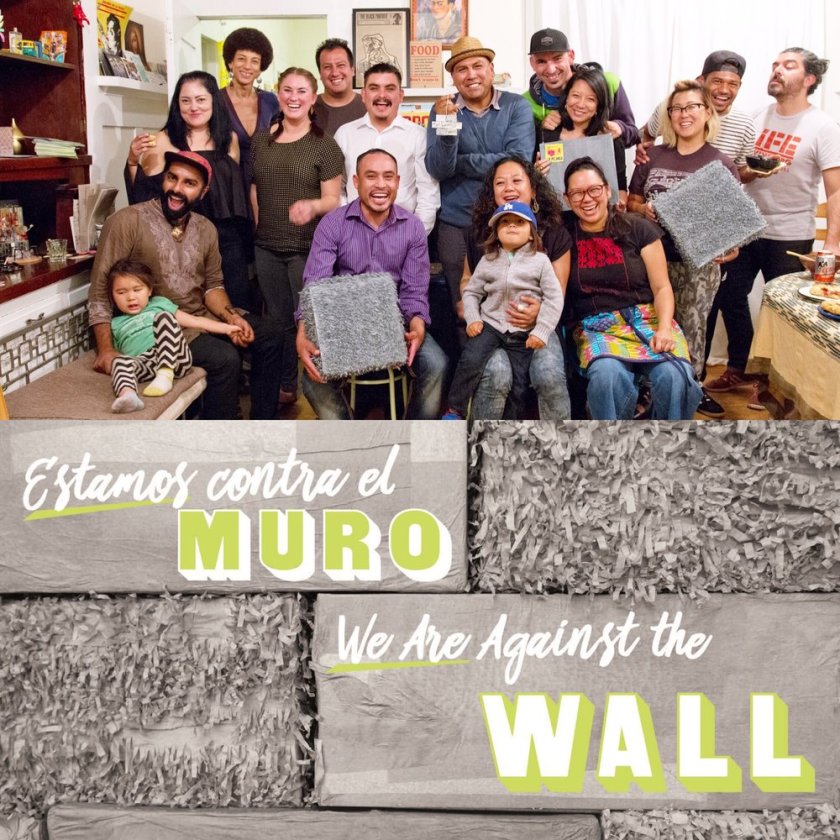
Bhaumik’s work is social practice that embraces the political. Its institutional critique intersects with critical race art history’s concerns.
All Power to the People: Black Panthers @50: Exhibition, Anniversary Commemoration, and Symposium (Fall 2016) at the Oakland Museum of California
The Panthers, in more ways than one, sought to visualize racial identity. Their model continues to inform new movements across the globe.
Revolutionary Art (circa 1969) by Emory Douglas, Black Panther Minister of Culture, Oakland, CA.
 .
.
CFP: Smack Mellon Call for emerging curators. Deadline: Sept. 1, 2016 — The Curator Ship

Proposals are accepted annually from Emerging Curators for the Emerging Artists Summer Exhibition. The Emerging Artists Summer Exhibition will be curated by a selected Emerging Curator and will be made up of Emerging Artists. An Emerging Curator is defined as an independent curator who is beginning their career as a curator. Proposal must show history […]
via Smack Mellon Call for emerging curators. Deadline: Sept. 1, 2016 — The Curator Ship
Call for Emerging Artists–Deadline Aug. 1, 2016

Tim Roseborough (and Cheryl Patrice Derricotte) were the 2015 Emerging Artists at the Museum of the African Diaspora (MoAD), San Francisco.
For more information on the 2016 Emerging Artist Program at MoAD, click below:
The Emerging Artists program at the Museum of the African Diaspora, San Francisco

Cheryl Patrice Derricotte (and Tim Roseborough) were the 2015 Emerging Artists at the Museum of the African Diaspora (MoAD), San Francisco.
Click here to apply to the 2016 Museum of the African Diaspora Emerging Artist Program.
Summertime — Genealogy Time
Art historian and visual cultural studies scholar Judith Wilson has brought our attention to the exhibition of a black woman’s portrait at the Middlesex County Historical Society in Connecticut.
This unattributed pastel on paper image (circa 1904) depicts Anna M. Warmsley (circa 1870s/1880s-1944). Warmsley (née Steadman [sp?]) lived in Middletown, Conn.
Judith saw Carla Halloway’s Facebook posting about this portrait last week. Ms. Halloway of East Hartford, Connecticut wrote that the portrait had been “rescued from the trash” and given to the historical society.
Ms. Halloway’s post generated a lively FB discussion, including comments from a descendant of Anna Warmsley and her husband Herbert Elmer Warmsley (1878/1881-1954). The historical society also has a portrait of Herbert Warmsley.
In online public records (US Federal Census, etc.) and others on ancestry.com, the Warmsley’s family name sometimes appears as “Warmesley.” In early records, Anna is termed a “Negro” and Herbert, whose listed profession was a “galvanizer” in a foundry, a “mulatto.” Anna was a housekeeper for “a private family. She married Herbert when she was about 21. (No marriage certificate appears online. But the US Federal Census of 1910 states that they had been married for five years.)
Who might have painted the Warmsley couple around 1904? They were people of some means and were respected in their community. Did they commission their portraits? White or other non-black artists may have taken up this job. And what about the possibility that the portraits were done by one of the several East Coast artists of color whose names and works we know today?
John G. (Gwynne) Chaplin (1828-1907) worked in Pennsylvania and Ohio, and painted representational mythological and Biblical themes, and portraits. A man of mixed ethnicity–European-American and African-American–Chaplin traveled to Germany and had a studio in Dusseldorf before returning to the US to settle in Youngstown, Pennsylvania. (The actor Charlie Chaplin [1889-1977] was once told that he was related to the artist Chaplin.)
Black Hartford native Nelson E. Primus (1842-1916) made his reputation as a portraitist. But he moved to San Francisco in 1895, so it seems unlikely that he painted the Warmsleys.
Charles Ethan Porter (1847-1923) was a black artist from Hartford. Porter’s still lifes and realist landscapes were admired in the late 19th and early 20th century, and they’re sought after now by collectors of African-American artists’ production. His brushy style seems quite different from the linear approach of the Warmsley portrait. Sounds like a good time to return to the monograph exhibition catalogues on Porter by Helen Krieble et al. (1987) and the New Britain Museum of American Art (2008).
Annie E.A. Walker (1855-1929) was born in Brooklyn, and appears to have spent her younger years in Alabama and in Dallas, Texas. She studied at the Corcoran School of Art in Washington, DC, and graduated from the Cooper Union School for the Advancement of Science and Art in 1895. (See this account of her Cooper Union years.) Afterward, she traveled to France and studied at the Academie Julian in Paris for several years. Her best known work is the Salon-exhibited pastel on paper called La Parisienne (Howard University Art Gallery). She returned the US in the first decade of the 20th century and worked in Washington, DC. Her career and activities were researched by James V. Herring (1942), James A. Porter (1967), Lowery Sims (1978), Andrew Cosentino and Henry H. Glassie (1983), Tritobia Hayes Benjamin (1993), and others. Yet Walker is an artist about whom we don’t know enough. Works are attributed to her here and there, including in some files I haven’t looked at in years. Time to blow the dust off those. More to come…

What does diversity look like?

On top of the Brexit vote, there’s another pitched battle being waged in the UK right now—it’s over a commissioned statue of Mary Seacole (1805-1881), a recognition for her aid and service to the wounded during the Crimean War (1853-1856).
Martin Jennings’s Seacole sculpture is scheduled to be installed at St. Thomas Hospital in London later this month. Opponents say it doesn’t belong at that hallowed site where Florence Nightingale established a nursing school. The opponents double-down when accused of racism by the artist Jennings and other supporters of the monument: Seacole, they claim, wasn’t a nurse nor did she–the child of a free, black Jamaican woman and a white Scottish solider–identify as “black.”
This is a row of great proportions. In the interest of Critical Race Art History, my raised question is “What does diversity look like?”
Sandra Gunning’s essay of 2001, “Traveling with Her Mother’s Tastes: The Negotiations of Gender, Race, and Location in WONDERFUL ADVENTURES OF MRS. SEACOLE IN MANY LANDS,” is a serious consideration of Seacole’s life and times.
 ACRAH
ACRAH 