The Art, Art History, and Film Department at Boston College seeks candidates with a robust film production agenda and a demonstrated record of experience in filmmaking (feature/ documentary/digital/video), who can teach and mentor undergraduate students in narrative and technical skills in film. Applicants should have at least three years of experience teaching film production. Besides teaching three filmmaking courses annually, candidates should have expertise in film history and be prepared to teach two film history courses (open specialization). Of particular interest are candidates whose work focuses on social justice issues and who can teach courses in one or more of the following areas: gender studies, critical race theory, post-colonial studies, and African-American or black diasporic cinemas. An MFA or a PhD with a production background is required by the time of appointment.
The Film Studies Program, situated in the Art, Art History and Film Department, includes in its curriculum film history, production, screenwriting, web design, cinematography, sound design and criticism. With its liberal arts basis as well as hands-on production experience, the program focuses on preparing students for graduate programs in film and/or careers in the media.
As a Jesuit, Catholic university Boston College strives to integrate research excellence with a foundational commitment to formative liberal arts education. The University further encourages applications from candidates committed to fostering a diverse and inclusive academic community.
Qualifications
An MFA or a PhD with a production background is required by the time of appointment.
Application Instructions
Applicants should submit a cover letter, curriculum vitae, teaching philosophy, course syllabi, research/filmmaking statement, sample of recent film production and/or scholarship, and names of potential references by October 15, 2021. In the research/filmmaking and teaching statements, applicants should address previous efforts and future plans to support diversity, equity, and inclusion in their research, filmmaking, and teaching activities. Candidates who are selected for the first-round interviews will be asked to submit reference letters within two weeks of notification. For questions about the position, please contact Professor John J. Michalczyk, Film Studies Director, john.michalczyk@bc.edu. All materials must be submitted to Interfolio.
The Grapevine
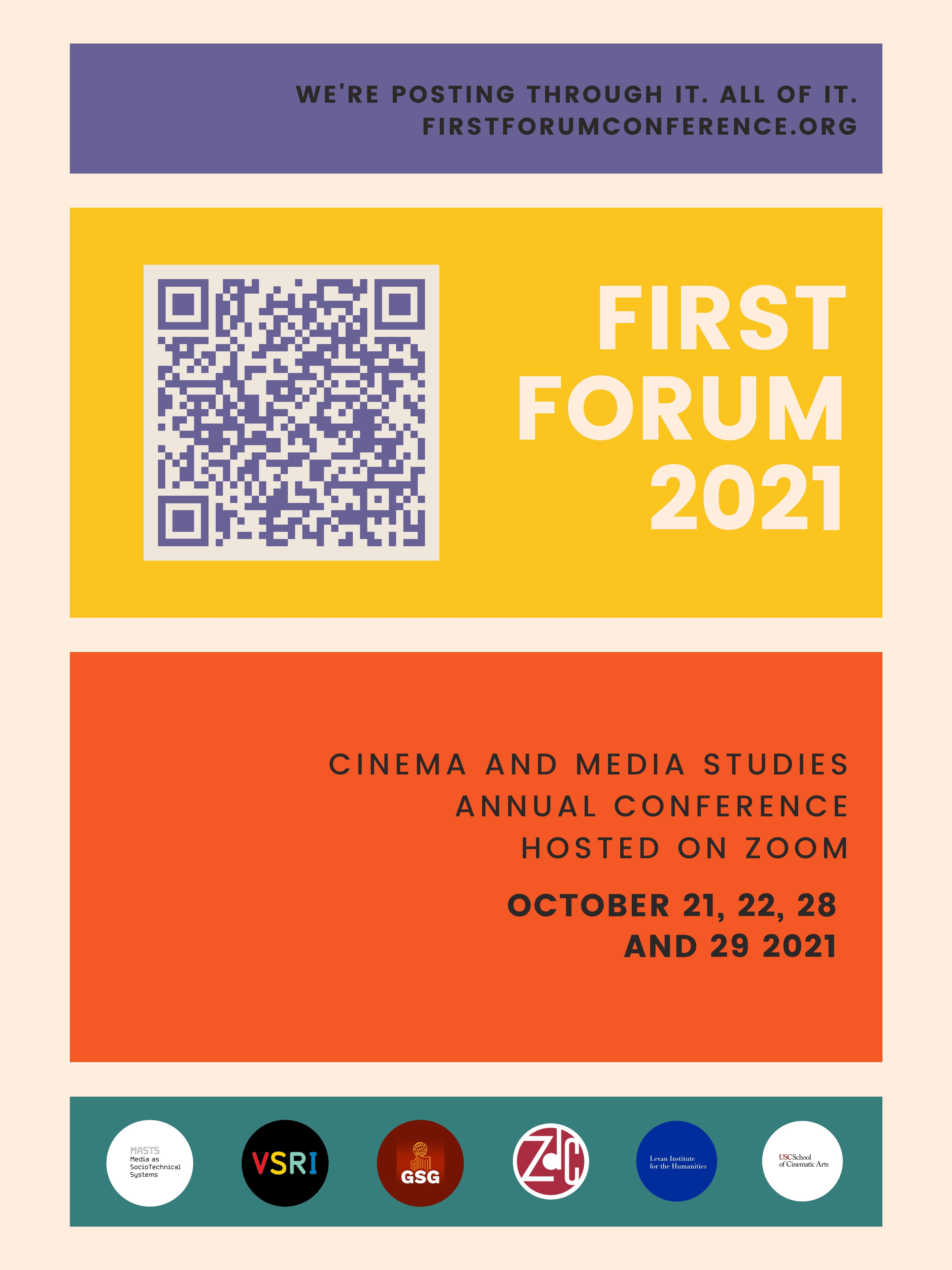
USC Cinema and Media Studies 2021 Graduate Student Conference [Oct. 21-22, 28-29]–
First Forum will be held virtually and the program schedule has panels and events spread out over two weeks on October 21, 22, 28, and 29. We have an exciting and dynamic set of speakers including our keynote speaker Dr. Bo Ruberg, an Associate Professor of Film and Media Studies at UC Irvine. Additionally, we will have a roundtable discussion featuring Dr. Erin Y. Huang, Dr. Camilla Fojas, and Dr. Ayesha Omer. You can find a full conference schedule on our website and through the QR code on the attached flyer. We look forward to seeing you there!
CFP: “In Situ” for Art Institute Review–deadline Mon., Oct. 11, 2021
CALL FOR PAPERS
Issue 3: In Situ (September 2022)
Deadline for proposals: Monday, October 11, 2021
This issue of the Art Institute Review addresses the concept of in situ—a natural, original, or existing position or place. The notion relates to basic questions art historians, conservators, curators, and other cultural heritage professionals ask about all works of art: Where were they installed or exhibited? How were they experienced in their original time and location? To what extent did these initial contexts orient and shape artistic intent? Location and place may change over time. What happens when the physical context of a work of art is interrupted or upended? What are the stakes surrounding its placement and/or displacement? Research and analysis are themselves informed by position and place. How are art historical, conservation, and material science methods shaped in situ? How must they change when addressing a work of art that has been removed from its original context(s)?
Such questions regarding the past, present, and future of artworks have always been important in art history and related disciplines, but they have taken on even greater weight in our particular moment. What does it mean to recontextualize works in new spaces? What happens when we privilege one point in an artwork’s history over another—or when we deprioritize or disregard that history? How can digital tools and technologies help us better understand, question, and critique the “place” of art?
The third issue of the Art Institute Review invites you to consider, interrogate, and visualize the concept of in situ, understood broadly. We welcome topics from an expansive geographical, temporal, and theoretical range that could include: archaeological investigation and research, theoretical and practical projects of restitution and decolonization; community-based conservation; site-specific artworks and interventions, Gesamtkunstwerk, and land art projects; digital and material re-creations of artistic sites and architectural settings; and more. We especially welcome proposals focused on historically underrepresented objects or narratives, proposals from emerging scholars, and proposals that optimize the digital platform. Not only is the digital realm itself a place ripe for critical exploration through the theme, but it also supports innovative technological experiments and creative realizations of historic, contemporary, and imagined spaces.
This issue is co-edited by Elizabeth McGoey, Associate Curator of Arts of the Americas, the Art Institute of Chicago, and Jeanne Marie Teutonico, Associate Director of Strategic Initiatives and Publications at the Getty Conservation Institute.
Submit proposals here.
For more information on what we’re looking for, visit the journal website, here.
We aim to review proposals and notify the authors of accepted proposals within approximately one month of receipt. Full manuscript is due about two months after notification.
Amalia Amaki at the Photography Network Virtual Symposium [October 7-9, 2021]
Artist and scholar Amalia Amaki will be our Keynote for “The Material and the Virtual in Photographic Histories” (October 7-9, 2021). The First Symposium of the Photography Network will be held virtually, jointly hosted by the Photography Network and Folkwang University of the Arts, Essen. We are looking forward to our conversation with her on Thursday, October 7 at 4:00-4:45 pm UTC (12:00–12:45 pm EST) about her impressive art range and her ability to stretch the limits of photography’s materiality. The three-day symposium will pair previously recorded presentations (now available to registered attendees) with live roundtable discussions and Q&A sessions on October 7th, 8th, and 9th.
Registration is open and the presentation videos are live for the First Symposium of the Photography Network (October 7–9, 2021), a virtual event. Register now! Registration for this free event is now open. Symposium attendees are required to be current Photography Network members in good standing. Annual membership is $20 (student/unaffiliated), $40 (Affiliated), or $100 (Sustaining Member). Please visit the Photography Network’s website for more information on how to join. Once a member, link to the live sessions under the Account feature by clicking “Symposium_live (affiliated).”
JOB: Curator, Folk and Self-Taught Art @ Museum of Fine Arts, Boston
At a transformational moment for our Art of the Americas program, the Museum of Fine Arts, Boston, seeks a creative, energetic and dynamic curator and scholar to become the inaugural Linde Curator of Folk and Self-Taught Art. Reporting to the Chair of the Art of the Americas, the Linde Curator will partner with the Katharine Lane Weems Senior Curator of Decorative Arts and Sculpture, and with colleagues in the Department of Learning and Community Engagement to lead the MFA’s newly launched folk art initiative, an ambitious new program designed to reimagine and reanimate the folk art collections for 21st-century audiences. The Linde Curator will have the opportunity to build a dynamic and experimental suite of exhibitions, installations, programs and displays that will reshape the institution’s commitment to folk and self-taught material, and align the display and interpretation of this material with the MFA’s larger strategic vision. A true thought leader, the ideal candidate will galvanize colleagues across the department and around the museum in thinking anew about the categories of folk and self-taught art, and in envisioning new ways to make this material accessible, relevant and important to the lives of our visitors today.
The Museum of Fine Arts has an impressive collection of American folk art, broadly defined, with notable strength in works made in the northeastern United States in the 18th and 19th centuries. Highlights include important paintings by Erastus Salisbury Field, William Matthew Prior, and Rufus Porter, nearly 350 works on paper from the Karolik collection, a significant collection of American quilts, and select examples of painted furniture and sculptural forms. Opportunities for growth include historical American art that enhances and complements the Karolik collection with a focus on artists of diverse ethnic, racial, socio-economic, and geographical background, as well as 20th and 21st century art by self-taught, Outsider and Visionary artists.
Candidate Profile:
Minimum Qualifications and Experience:
- A Master’s or PhD in Art History, history or related field with a proven focus on Folk, Self-taught and Visionary material.
- Three to five years of experience in a museum or comparable institution.
- Demonstrated curatorial ability through culturally-meaningful exhibitions, gallery displays, programs or other activities.
- Demonstrated experience and a strong interest in working in a museum setting.
Ideal Candidate Profile:
- Committed to researching, caring for and interpreting Folk and Self Taught art for diverse audiences, and to thinking about this material in new ways.
- Demonstrated experience contributing to/leading exhibitions, programs and projects developed in collaboration with artists, visitors, community leaders, and other scholars and experts.
- A breadth of knowledge and experience, as well as a willingness to gain expertise in new areas. An interest in and commitment to exploring the changing nature of art museums and their relationship to the public.
- A national perspective but experienced in becoming personally and professionally committed to the city of Boston, its people and artistic community.
- Experience working closely and building relationships with colleagues in a museum setting.
- Experience working in partnership and engaging with donors, collectors, scholars, external communities and other partners.
- Strong planning and project management skills with the ability to manage various projects simultaneously and to collaborate with colleagues across the institution to achieve the best outcome.
- Strong sense of accountability for achieving stated objectives.
- Team-oriented and collaborative.
- Superb presentation and interpretation skills with ability to attract and engage audiences of all demographics.
- Superior ability to present and defend ideas and projects that earn the respect of colleagues and Museum’s leadership and builds credibility for the department and institution.
Personal Qualities and Attributes:
- Intellectually rigorous
- Inspirational, passionate, curious
- Generous of spirit, a team player
- Superior judgment, tact and diplomacy, with good organizational skills
Salary Range:
Full-Time Salary, 35 hours per week
Starting salary: $73,000 – $78,000
The MFA is an Equal Employment Opportunity Employer that is committed to building a culturally diverse staff and strongly encourages applications from diverse candidates.
Link to apply: https://bit.ly/3zYMORb?
Competition for the 2022 ALAA/LASA-VCS Afro Latin American/Afro-Latinx Scholarship Prize
The Association for Latin American Art, an affiliate of the College Art Association, and the Visual Culture Section of the Latin American Studies Association, are pleased to sponsor the ALAA Annual Afro Latin American/Afro-Latinx Essay Prize. We will consider scholarly essays published in a peer reviewed journal, edited volume, or exhibition catalogue during the previous year, on any aspect of Afro Latin American art, architecture, or visual culture in Latin America and the United States, covering any period from the colonial era to the present. The award consists of a $500 honorarium and will be presented at the ALAA business meeting at the annual meeting of the College Art Association in February as well as the LASA business meeting at the annual conference in April. The name of the recipient will appear in the newsletters of both ALAA and LASA.
For the February 2022 Award, we will evaluate articles that meet the following criteria:
• Publication date between September 1, 2020 and August 31, 2021.
• Essays may be written in English, Spanish, or Portuguese.
Essays will be evaluated by a three-person committee of accomplished scholars in the field, each with expertise in a wide geographical and temporal range. For consideration, authors should send their submission as a pdf to the Chair of the award committee no later than November 15, 2021. Peer nominations will also be accepted.
Afro Latin American/Afro-Latinx Scholarship Prize Committee
Paul Niell, pniell@fsu.edu
Mey-Yen Moriuchi, moriuchi@lasalle.edu
Tamara Walker, tamara.walker@utoronto.ca
Assistant Professor/Associate Professor, Tenure-track in Department of Architecture, University of Buffalo (State University of New York). Applications due by Sept. 30, 2021
Info here.
Director of Visitor Experience, MASSMoCA–Apply now.
Info is here.
Assistant Professor, Tenure-track, Modern and Contemporary Arts of the Americas, Department of the History of Art, University of Michigan. Applications due by Nov. 1, 2021
Job Description:
The Department of the History of Art at the University of Michigan invites applications for a full-time, tenure-track assistant professor position in the arts of the Americas, modern and contemporary, beginning in September 2022. Scholars working in American art and/or visual and material cultures, with an area of specialization in African American, African Diaspora, Latinx, Asian American, and/or Indigenous cultures are especially welcome. We seek to complement current departmental strengths with a candidate committed to race and gender theory, museum studies, decolonization, and/or settler colonial studies.
The successful applicant will be asked to develop a range of undergraduate and graduate courses, to supervise doctoral dissertations, and to participate actively in the life of the department. The appointee will be welcomed into a large university community that encourages interdisciplinary dialogue and is committed to the core values of diversity, equity, and inclusion. Applicants should provide a cover letter, CV, statement of current and future research plans, statement of teaching philosophy and experience, personal statement demonstrating engagement with issues of equity (described in greater detail below), evidence of teaching excellence, and a writing sample.
The personal statement and diversity commitment should include your demonstrated commitment to diversity, equity, and inclusion through scholarship/research, and/or teaching/mentoring, and/or service/engagement. There may be some overlap with your research proposal and teaching statements (1-3 pages).
Application materials, personal statement and diversity commitment, and three letters of reference should be uploaded via Interfolio (http://apply.interfolio.com/89267). The deadline for submission is November 1, 2021. A PhD is required prior to beginning this university year appointment. If you have questions regarding the position, please contact Audra Wilson (Executive Secretary, U-M Department of the History of Art) at histart-execsec@umich.edu.
The University of Michigan, is an equal opportunity/affirmative action employer and is supportive of the needs of dual career couples. Women and minority candidates and scholars demonstrably committed to working with diverse student populations are encouraged to apply.
We acknowledge that the University of Michigan, named for Michigami, the world’s largest freshwater system, sits on land stewarded by Niswi Ishkodewan Anishinaabeg–the Three Fires People, who are the Ojibwe, Odawa, and Potawatomi–along with their neighbors the Seneca, Delaware, Shawnee, and Wyandot nations.
Post-doc in the humanities, and the social and natural sciences at University of Michigan, deadline Oct. 4, 2021
Info is here.
 ACRAH
ACRAH 