Anything With Nothing: Kemar Black

nationalgalleryofjamaica's avatarNational Gallery of Jamaica

Kemar Black at work on The Creation Kemar Black at work on The Creation

Kingston-based Fashion designer, musician and street artist is one of 10 artists presently featured in the National Gallery of Jamaica’s Anything with Nothing exhibition. Below is a short interview with him, produced with much-appreciated assistance from the African-Caribbean Institute of Jamaica/Jamaica Memory Bank.

An artist and entrepreneur from “up-town and down-town”, Black was associated with Roktowa, an arts initiative based in the old Red Stripe Brewery on West Street. He designs dancehall fashion and writes music and poetry. For the exhibition he has painted four large scale versions of his dancehall fashion drawings entitled The Creation.

Kemar had the following to say: “…Doing artwork from the day my mother shove me out the womb – from me born me ah artist – from day one. Am mostly self-taught but my father is an artist, Winston Black, for years I always see my father…

View original post 167 more words

SMBH Photography Call: ‘The Face of Latin America’. Deadline: Aug. 1, 2014

JOB: Assistant Professor, Tenure-track, American Art 1945-Present @ University of Delaware

The Department of Art History at the University of Delaware invites applications for a full-time, tenure-track assistant professor in the history of art from 1945 to the present with specialization in American art. We seek candidates who approach the history of American art within a global context. We are committed to hiring a scholar who shows exceptional promise as an intellectual leader. In addition to pursuing an ambitious research agenda, the appointee will teach undergraduate and graduate courses from the mid-twentieth century to the present and supervise masters and doctoral students.

The successful applicant will join a department about to celebrate the 50th anniversary of its establishment and its doctoral program. Recognized as a leader in American art and architectural history, the department offers comprehensive training in the historical and geographical scope of the discipline and recently launched a Curatorial Track Ph.D. program. The ideal candidate will enhance these strengths and engage University-wide initiatives in globalism, diversity, public humanities, and/or digital humanities. The University of Delaware offers many opportunities for interdisciplinary outreach, including partnerships with the departments of Art, Art Conservation, Black American Studies, Women and Gender Studies, and the Winterthur Program in American Material Culture, as well as programs in area studies, design, Museum Studies, and the University Museums. We seek a faculty member who will make the most of these collaborative opportunities.

Founded in 1743, the University of Delaware is one of the nation’s oldest institutions of higher education and combines tradition and innovation. Please visit our website at www.udel.edu. The University of Delaware is an Equal Opportunity Employer and encourages applications from minority group members and women.

The appointment will begin on September 1, 2015. Ph.D. required. Application deadline: September 12, 2014. Applicants should visit www.udel.edu/udjobs and read “Applicant Instructions” under the “Resources for Applicants” tab before submitting their application. Applicants are asked to create and upload a single document that includes a cover letter and a c.v. Please also arrange for one writing sample and three letters of recommendation to be sent via e-mail or regular mail by September 12 to Professor Wendy Bellion, Chair, Search Committee, Department of Art History, 318 Old College, 18 East Main Street, Newark, Delaware 19716-2516 (wbellion@udel.edu). Incomplete dossiers will not be reviewed. Application materials will be shared with the faculty of the Department of Art History.

A Walk in Their Shoes

Progressive Pupil's avatarThe Progress

nl_hispanic25

How dare she? At first glance Korean American artist Nikki S. Lee may come off as a mockery. She explores the subject of identity through photography. In her seminal series titled “Projects,” you see her disguised as a member of a number of American sub-cultures and social identities: senior citizen, Korean school girl, swing dancer, lesbian, exotic dancer, and a skate boarder, amongst many others. Above you see her as a Latina woman. I was slightly offended when I saw her portraying a black woman with corn rows chillin’ wit da homies, or squeezed between her two home girls with a face full of exaggerated makeup. I questioned whether or not she was just posing for fun, or if there was a deeper meaning. To understand her better, I watched a short clip where she, in her native Korean language, talked about her artwork. She talked…

View original post 489 more words

CFP: “BUILDING A MULTIRACIAL AMERICAN PAST” @ CAA 2015

Chair: Susanna Gold, Tyler School of Art, Temple University, gold@temple.edu

The dynamics of mixed race heritage has long been a stable point of inquiry in historical American literature, music, theater, politics and speech, but this issue has been thought to emerge less often in visual culture.  There are very few examples of American art that follow the tradition of 18th-century Mexican and Peruvian casta paintings illustrating the practice and results of mestizaje, the mixing of distinct categories of peoples and the development of new peoples.  But are American images of multiracialism truly rare, or is the art historical scholarship limited because there lacks a clear academic understanding of which images can be understood to address mixed race heritage?  Is there a cultural tendency for scholars to classify figures in American art according to an overly determinate white/non white dichotomy, which avoids the relevance of a shared, divided, or indistinct racial ancestry?  This session invites papers that enlarge the art historical scholarship on race mixing, and provide new possibilities for recognizing and analyzing how complexities of a multiracial heritage affected identity construction and found expression in visual imagery.  Papers that address art practices in the art of the United States, 18th-20th centuries, are welcome.

Please send paper title, abstract (200-300 words), curriculum vitae, and letter of interest to Susanna Gold (gold@temple.edu) by May 9, 2014.
For more information about the 2015 conference, please see: http://www.collegeart.org/pdf/2015CallforParticipation.pdf

CFP: “Solid as a Rock?: African American Sculptural Traditions and Practices” @ CAA 2015

Colleagues,
Please consider submitting a proposal for the CAA 2015 session, to take place in New York and that I will be chairing, titled “Solid As A Rock: African American Sculptural Traditions and Practices.” The official deadline is May 9 for proposals. Please send to smalls@umbc.edu.

Many thanks.


Here is my original call for proposals:

Solid as a Rock?: African American Sculptural Traditions and Practices

Sculpture has always been an intricate part of the history of African-American art and yet African American sculptural traditions and practices have not been sufficiently historicized or critically questioned. Venturing beyond focus on artist’s biographies, this panel sets out to investigate and deconstruct the multi-accentual critical, aesthetic, and thematic aspects of sculptural traditions and practices engaged in by African American artists. It seeks to interrogate not only the assumed, if not expected, operations of racial identities, but also those of gender, sexuality, and class. What are the conceptual/ideological gaps, cracks, and fissures that are provoked in thinking of African American sculptural traditions and practices exclusively in terms of race and racial identity? Is there anything singular about sculpture as a medium that is particularly relevant or critical for African American cultural expression? How might we reconcile sculpture’s inherent conservatism as a medium with African American progressive intent/content? What strategies of identity (re)negotiation do African American sculptors engage in in figurative, abstract, and conceptual modes of sculptural practice and how are these manifested given sculpture’s limitations as a medium? This panel embraces different methodological approaches and critical perspectives from any historical period relevant to the intersectional history, theory, and criticism of African American sculptural traditions and practices. As well, it welcomes thoughtful critique of the very terms “sculpture,” “traditions” and “practices” in relationship to African American visual art and culture.

Call for Submissions: Mirror of Race

Mirror of Race (http://mirrorofrace.org) is seeking submissions of artwork and essays for online publication.

The goal of MoR is to explore ideas about race in the United States through personal and critical reflections on early photography. The editorial board encourages submissions from artists, writers, educators, curators, and scholars that engage with the photographs in the MoR online exhibition, that situate images within their historical contexts, and that can inspire visitors to the website to reexamine their own ways of seeing race. MoR aims to address the general public as well as instructors and students at all educational levels.

Submissions to MoR are peer reviewed by members of the editorial board and external readers. A list of suggested formats and topics can be found on the MoR website. Essays should adhere to the standards of excellence in the author’s field, but they should be written in accessible language for the MoR’s broad audience. They may address any aspect of race, including contemporary topics, but must engage in some way with the images in the MoR online exhibition. Artwork may include original photographs, paintings, poetry, storytelling, and other creative forms that can be exhibited online. Artists should provide a narrative explaining the relationship between their work and the images and themes featured on the MoR website.

For more information please contact Gregory Fried, Mirror of Race Project Director, gfried@suffolk.edu


TEACHING: Baucom and DuBois Course Site for “The Black Atlantic”

Jessica Marie Johnson's avatar#ADPhD

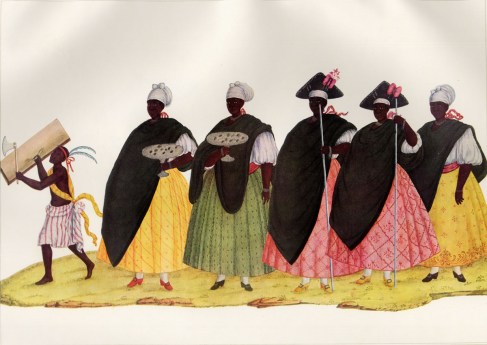
“Festival of Our Lady of the Rosary, Rio de Janeiro, Brazil, ca. 1770s,” from “The Atlantic Slave Trade and Slave Life in the Americas” [Click]

Duke University students are writing the “Black Atlantic” online courtesy of a course taught by Ian Baucom and Laurent DuBois.

From the syllabus:

“This seminar, open to advanced undergraduate students and graduate students in all disciplines, explores the history and literature of what has come to be known as “The Black Atlantic.” Our goal will be to think through the histories of slavery and emancipation in this Atlantic world and the way they have shaped our politics and culture. Our reading will range widely, including works of history and theory as well as poetry and novels. But we will also explore how visual art, music, and various types of performance condense, transmit, and examine this history. Students in the class will be invited to participate…

View original post 104 more words

The Resurgence of Jim Crow

Progressive Pupil's avatarThe Progress

Photo courtesy of NPR.org Photo courtesy of NPR.org

The emergence of Barack Obama as a prominent political figure inspired African American voters in 2008 to turn out in higher numbers than ever before, closing the gaps in voter turnout. The implication is that the racial divide in American has ‘evaporated’ and that we have moved to an America beyond race. This single instance has been the fuel for right wing white ruling class to achieve the goal that they have long been working for: To remove the protective voting rights for African Americans, the same protective measures that culminated in such a successful turnout in 2008.

View original post 491 more words

The Campaign against Skin Bleaching

Progressive Pupil's avatarThe Progress

Courtesy of msxlabs.org Courtesy of msxlabs.org

Skin bleaching can be disguised as a beauty fad, but it tells a story much deeper than the shades of these people’s complexions. It is a procedure thought to bring out a beautiful, more attractive visage, but only in exchange for the increased probability of long term health consequences including (but not limited to) skin cancer, chemical poisoning, liver and kidney failure.

View original post 296 more words