Forgotten Histories of New Deal Art in Florida — Living New Deal Webinar (Mar. 25, 2025, 5PM PST/8PM EST)

Forgotten Histories of New Deal Art in Florida

Tuesday, March 25, 5:00PM PST/8:00PM EST

Here is the link to register for the webinar: https://www.eventbrite.com/e/forgotten-histories-of-new-deal-art-in-florida-tickets-1257489247189?aff=oddtdtcreator

Description:

As one of the largest and oldest states in the American South, Florida, the Sunshine State, is a powerhouse of industry, leisure, entertainment and politics in the twenty-first century. It is also crucial for understanding the diverse history of New Deal art and public works. This webinar describes how New Deal emergency relief and recovery programs impacted Florida, particularly programs that funded the construction of public space and public access to art.

Co-hosted by Dr. Mary Okin, Living New Deal’s Assistant Director and head of the Advocating for New Deal Art initiative, and Jeff Gold, Member of LND’s New York City Chapter, the webinar features Dr. Mary Ann Calo and Dr. Keri Watson in conversation with one another about their research into Florida’s New Deal history. The talks will center on confronting the complex legacies of New Deal public works and public art programs in Florida in the twenty-first century, and the challenges of researching this era of Floridian history, as both scholars reconstruct the regional diversity, range of local participants, and just how many of Florida’s New Deal projects survive.

Speakers:

Dr. Mary Ann Calo is the Batza Professor Emerita of Art and Art History at Colgate University where she taught courses on the art of the United states, Modern and Contemporary Art, and the Arts and Public Policy. She is the author of numerous publications on the critical and institutional contexts that shaped discourse on African American art in the interwar decades. Her recent book, African American Artists and the New Deal Art Projects (Penn State University Press, 2023), explores the African American community’s participation in the “projects” in terms of intersecting issues of race, access, and opportunity.  The book includes extensive archival research and new insights into the history of the Federal Art Project in Florida. 

Dr. Keri Watson is an Associate Professor of Art History at the University of Central Florida and a specialist in the history of American art. Her most recent book Florida’s New Deal Parks and Post Office Murals (History Press, 2024) introduces general audiences to the history of New Deal public works with a general audience, exploring the rich history of state parks and post offices built in Florida between 1931 and 1946 under the auspices of the Civilian Conservation Corps, Public Works Administration, Civil Works Administration, Works Progress Administration, and Treasury Section of Painting and Sculpture. Looking at Florida’s Depression-era parks and post offices in concert elucidates how the natural and built environments work together to constitute the cultural landscape and provides insight into the role of the federal government in Florida’s construction as an exotic and tropical paradise.

Jeff Gold, Living New Deal New York City Chapter 

Jeff Gold is an urbanist who has earned his living as an acquisitions editor, a partner at new media partnership JIA, and director of the Institute for Rational Urban Mobility (IRUM), an eco-transport nonprofit. He also chairs the steering committee of the Metro New York Health Care for All Campaign and serves on the board of the National Jobs for All Network. And he’s active in electoral politics at the local, state, and national level.

https://www.eventbrite.com/e/forgotten-histories-of-new-deal-art-in-florida-tickets-1257489247189?aff=oddtdtcreator

WEB: Black Beauty Archive, Feb. 19

Webinar: “Hidden Histories: Rediscovering the Federal Art Project at the Saint Louis Art Museum”

Greetings,  

I’m writing to announce the free Living New Deal webinar “Hidden Histories: Rediscovering the Federal Art Project at the Saint Louis Art Museum” at 5 PM Pacific Standard Time on Tuesday, February 4, 2025.

To register, click on the link below

We invite you to join us for a webinar with John Ott, Professor of Art History at James Madison University, and Amy Torbert, the Andrew W. Mellon Foundation Associate Curator of American Art at the Saint Louis Art Museum and co-curator of the current exhibition The Work of Art: The Federal Art Project, 1935–1943. Their conversation will offer a behind-the-scenes look at the planning process for this show, relate forgotten and untold stories from our nation’s artistic past, and illuminate neglected contributions from women, immigrant, and minority artists.

Co-curated with Clare Kobasa, SLAM’s associate curator of prints, drawings, and photographs, The Work of Art presents a remarkable collection of artworks created amidst the hardship of the Great Depression. In 1934, President Franklin D. Roosevelt launched a series of national initiatives for the visual arts as part of the New Deal. The largest and most ambitious program, the Federal Art Project (FAP) (1935–43), put more than 10,000 artists on the federal rolls. The resulting artworks decorated municipal spaces, toured the nation in travelling shows, and eventually found homes in institutions across the country.

When the FAP ended in 1943, the Saint Louis Art Museum received a trove of 256 prints, drawings, watercolors, and paintings. This exhibition draws from this rich collection to explore how this federal program expanded opportunities to create and encounter art in many different communities, some of which had historically lacked the necessary infrastructure and support for the arts. By displaying work made by African American, Asian American, female-identifying, and immigrant artists, The Work of Art testifies to and keeps alive the New Deal’s ambition to nourish individuals and communities of every kind through the arts. Organized by geography, this showcase also reveals the complexities of the nation’s creative landscapes and art’s capacity to bridge communities near and far.

LECTURE SERIES: To Mind and to Mend/Collective for Anti-Racist Art History (CARAH), University of Zurich

ACRAH’s co-directors Jacqueline Francis and Camara Holloway will be presenting as a part of this series. See below.

https://www.khist.uzh.ch/de/chairs/moderne/events/To-Mind-and-to-Mend–Antirassistische-Praktiken-in-der-Kunstgeschichte.html

REGISTER: https://www.khist.uzh.ch/de/institut/registration.html

Focusing on Europe, where anti-racist initiatives and practices are still little established within universities and cultural institutions, this lecture series discusses how art history can assume a more self-critical stance to actively counter racism in all its forms. In what ways can anti-racist and decolonial efforts be fostered through art historical research and teaching, as well as the contextualisation of artworks or collections? What are necessary interventions or existing best practices within the discipline of art history in order to critically engage with racist representations or historical attributions? To what extent can the use of appropriate language prevent the entrenchment of stereotypes and prejudices? And how can debates on inclusion and diversity be sustainably incorporated within academia, museums and art academies? These and other questions will be addressed in the course of the lecture series by art historians, curators, art critics and art educators.

Programme: 

03.10.: Is Art History Racist?

Anne Lafont (Professor in art history and créolités, École des hautes études en sciences sociales, Paris)

[English]

10.10.: Working Towards a Critical Race Art History

Association for Critical Race Art History (ACRAH) – Jacqueline Francis (Dean, Humanities & Sciences Division, California College of the Arts, San Francisco) & Camara Dia Holloway (Project Manager, Romare Bearden Digital Catalogue Raisonné, Wildenstein Plattner Institute, New York)

[English]

*Online

31.10.: «Gastarbeiter» aus der Türkei und die Immobilität der weissen Kunstgeschichte Westdeutschlands

Gürsoy Doğtaş (Kunsthistoriker und Kurator, Forschungsstipendiat 2024/25 für Curatorial Studies, Städelschule und Goethe Universität, Frankfurt a.M.)

[Deutsch]

07.11.: Cause and Effect: On the Audience of Andrea Fraser at Luma Westbau

Brit Barton (artist and art writer, Zürich/Chicago)

[English]

21.11.: Antirassistische Strategien in Museen und kulturellen Institutionen

Gespräch mit Tasnim Baghdadi (Co-Leiterin Migros Museum für Gegenwartskunst, Zürich), Eric Otieno Sumba (Autor und Forscher, Redakteur am Haus der Kulturen der Welt, Berlin), Marilyn Umurungi (Kunst- und Kulturforscherin, Co-Kuratorin Schweizerisches Nationalmuseum, Zürich)

[Deutsch]

*Cabaret Voltaire, Spiegelgasse 1, 8001 Zürich

05.12.: Documenting Colonial Toxicity

Samia Henni (Assistant Professor of History and Theory of Architecture and Director of Graduate Studies, McGill University, Montreal)

[English]

*Online

12.12.: Invisible Man. Race und Fototheorie

Christopher Nixon (Philosoph und Komparatist, Hamburg)

[Deutsch]

***

Konzept und Organisation / Concept and organization

CARAH – Collective for Anti-Racist Art History

Daniel Berndt, Nadine Helm, Nadine Jirka, Charlotte Matter, Rosa Sancarlo

Weitere informationen / Further information

www.khist.uzh.ch/de/research/projects/carah.html

Die Vortragsreihe ist kostenlos und öffentlich zugänglich. Die einzelnen Vorträge werden auf Deutsch oder Englisch gehalten (siehe Programm). Einige Sitzungen finden virtuell statt. Alle Vorträge werden online mit Untertitelung übertragen. Für Fragen und Bedürfnisse zur Barrierefreiheit, sowie für die Anmeldung zur Online-Teilnahme schreiben Sie bitte an CARAH: antirassismus@khist.uzh.ch

The lecture series is free and open to the public. Individual sessions will be held in German or English (see program). Some sessions will take place online. All lectures will be streamed online with subtitles. For questions and accessibility needs, and to register for online participation, please write to CARAH: antirassismus@khist.uzh.ch

Mit der Unterstützung von / With the support of:

  • Kunsthistorisches Institut UZH
  • Lehrstuhl für Moderne und Zeitgenössische Kunst und Lehrstuhl Geschichte der bildenden Kunst
  • Graduate Campus UZH
  • Graduiertenschule der Philosophischen Fakultät UZH
  • Dr. Carlo Fleischmann Stiftung

“Pathways to Rochester Institute of Art: Art and Design Edition” — Academic Open House, Wed., Aug. 14, 2024, 1-2:30PM EST (via Zoom)

Pathways Art and Design Edition

Log into an “academic open house” to learn more about faculty career paths and opportunities within the Rochester Institute of Technology College of Art and Design (Rochester, NY, USA). RIT encourages historically underrepresented minority and women MFA or PhD candidates and graduates who are practicing artists, designers and photographers to register. This session is aimed at those interested in exploring a faculty role at RIT.

  • Learn about the College’s strategic plan and areas of growth
  • Get your job search questions answered and discover what search committees look for
  • Find out about anticipated or current faculty openings 
  • Understand expectations of incoming faculty
  • Hear from faculty and administrators about the culture and working environment at RIT 

Artists in the following disciplines represented within the College of Art and Design are invited to register:

3D Digital Design | Ceramics | Film and Animation | Fine Arts Studio | Furniture Design | Glass | Graphic Design | Illustration | Industrial Design | Interior Design | Medical Illustration| Metals and Jewelry Design | Motion Picture Science  | New Media Design | Photographic and Imaging Arts (Advertising/Fine Art/Photojournalism/Visual Media Options) | Photography and Related Media | Photographic Sciences | Studio Arts | Visual Arts-All Grades | Visual Communication Design.

Register here: https://bit.ly/PathwaystoRIT

Questions can be directed to: LOSOFR@RIT.EDU.


“Enduring Legacy: Conversations on Romare Bearden” Zoom webinar series in May

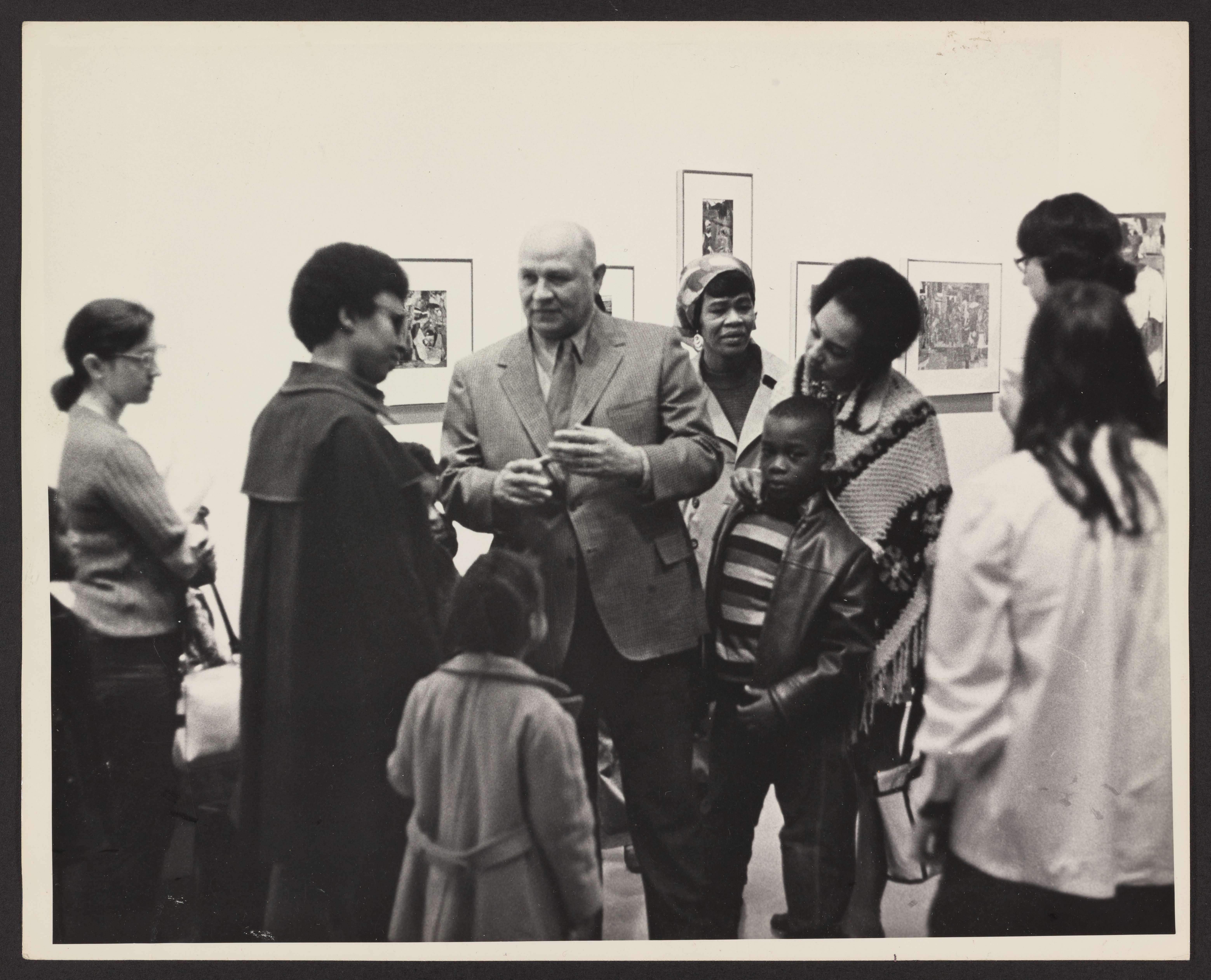
Bearden with Betty Blayton and Children’s Art Carnival students; “Romare Bearden: The Prevalence of Ritual” at the Studio Museum in Harlem, 1972; Romare Bearden Papers [ysqdockk], The Wildenstein Plattner Institute, Inc.

We hope you can join us for an exciting series running throughout May 2024 hosted by the Wildenstein Plattner Institute: 

ENDURING LEGACY: Conversations on Romare Bearden 

This event series features three speakers whose scholarship and practice engage with Bearden’s formulation of the visual world. 

Curating Romare Bearden with Charlie Farrell 

Wednesday May 8, 2024 at 1 pm

Registration link

Charlie Farrell will discuss the exhibition Romare Bearden: Resonances at the Saint Louis Art Museum. The show features Bearden’s important collage, Summertime (1967), alongside other collage works from the Museum’s collection. The aim is to trace Bearden’s influence and relationships with other artists, grounding him in a continuum of Black creativity. 

Situating the Projections with Anne Monahan 

Wednesday May 15, 2024 at 1 pm

Registration link

Anne Monahan will discuss her chapter on Bearden from her manuscript in progress, “A Usable Past”: Race, Figuration, and Politics in the 1960s. Her research on Bearden reconsiders his breakthrough Projections exhibition in 1964, exploring his turn to photomontage, how race factored into the works’ reception, and the impact of this work on a rising generation of artists of color.

Conceptualizing Black Joy with Kahlil Robert Irving

Wednesday May 22, 2024 at 1 pm

Registration link

Kahlil Robert Irving will discuss his artistic practice, including the pieces that were included in the recent exhibition, In Common: New Approaches with Romare Bearden, held at the New School in New York City. The show featured the work of six contemporary artists alongside that of Bearden.


These conversations commemorate Bearden’s continuing impact thirty-six years after his passing. The insight of his work resonates with our present moment and contemporary questions of race in America. More information can be found on our website.

Check out the conversation “Vision is a Battlefield: Histories of Race and Media”

Vision is a Battlefield: Histories of Race and Media

Event held March 26, 2024 at the Graduate Center, CUNY

How is our basic perception of the world influenced by concepts of racial identity? Join us for an illuminating discussion with the authors of four recent books exploring the intertwined histories of photography, media, and race. The panel of experts on art and visual culture features Brooke Belisle, associate professor of art at Stony Brook University, speaking on computational imagery and AI; Emilie Boone, assistant professor of art history at New York University, on Harlem Renaissance photographer James Van Der Zee; Monica Huerta, assistant professor of English and American studies at Princeton University, on the aesthetics of racial capitalism; and Nicholas Mirzoeff, professor of media, culture, and communication at New York University, on the visual politics of whiteness. Claire Bishop, professor of art history at the CUNY Graduate Center, moderates.

Lecture: “Black Capitalism and the City: African American Insurance Companies and the Actuarial Imagination” (Fri., Oct. 20, 2023—5:30 PM CDT)

Join the Graham Foundation, Places Journal, and the Society of Architectural Historians (SAH) for the inaugural SAH | Places Prize Lecture by architectural historian Ginger Nolan. Nolan is the inaugural recipient of the SAH | Places Prize on Race and the Built Environment, a unique collaboration between SAH and Places that supports the production of a major work of public scholarship that considers the history of race and the built environment through a contemporary lens.

Nolan’s talk explores how African American-owned insurance companies negotiated the (often vexed) aims of pursuing financial gain while also trying to create more equitable cities. For most of the twentieth century, these insurance companies controlled more wealth than any other African American enterprise and played an outsize role in shaping cities and suburbs. In efforts to reverse the effects of redlining, disinvestment, and segregation, these companies used housing developments and corporate architecture—including the first and only African American skyscraper—to redress discriminatory forms of urbanism and racial stereotypes. The talk will evaluate the urban and architectural interventions of African American insurance companies, using the companies’ office buildings, housing developments, and mortgage-lending practices to engage debates around Black capitalism and Black Marxism. While recent scholarship has focused on the biopolitical tendencies of the white-owned insurance industry, the history of African American insurance demands a more subtle analytical framework, as these companies’ efforts vacillated between the biofinancial logics of actuarial techniques and, on the other hand, strategies of care and contestation.

Following the talk, architectural historian Charles L. Davis II will moderate a discussion with Nolan. Davis is an associate professor of architectural history and criticism at the University of Texas at Austin and chair of the SAH Race + Architectural History Affiliate Group.

Free registration here. The talk will be held at the Graham Foundation for Advanced Study in the Fine Arts; it will be live-streamed via YouTube and registrants will receive the link in advance.

SAH will host a reception at the Charnley-Persky House, located at 1365 N Astor St, immediately following the event.

This program is presented in partnership with the Chicago Architecture Biennial: CAB 5: This is a Rehearsal.

Ginger Nolan is an assistant professor of architectural history and theory at the University of Southern California. Her research explores relationships between architecture, media technologies, race, and governmentality. She is the author of Savage Mind to Savage Machine: Racial Science and Twentieth-Century Design (2021) and The Neocolonialism of the Global Village (2018), both published by the University of Minnesota Press. She is currently researching race, actuarial thought, and urbanism, focusing on the role of twentieth-century African American insurance companies in shaping cities and suburbs in the United States.

Founded in 1940, the Society of Architectural Historians is an international nonprofit membership organization that promotes the study, interpretation and conservation of architecture, design, landscapes and urbanism worldwide. SAH serves a network of local, national and international institutions and individuals who, by profession or interest, focus on the built environment and its role in shaping contemporary life. SAH promotes meaningful public engagement with the history of the built environment through advocacy efforts, print and online publications, and local, national and international programs.

Founded at MIT and Berkeley in 1983, Places Journal is an independent, nonprofit journal of public scholarship on architecture, landscape, and urbanism. Bridging from the university to the profession to the public, Places features scholars, journalists, designers, and artists who are responding to the profound challenges of our time: environmental health and structural inequity, climate crisis, resource scarcity, human migration, rapid technological innovation, and the erosion of the public sphere.

Founded in 1956, the Graham Foundation for Advanced Studies in the Fine Arts fosters the development and exchange of diverse and challenging ideas about architecture and its role in the arts, culture, and society. The Graham realizes this vision through making project-based grants to individuals and organizations and producing exhibitions, events, and publications.

LEC: “Race Matters: Cultural Politics in the 1960s” webinar series on Zoom in September

We hope you can join us for this exciting webinar series hosted by the WPI, Race Matters: Cultural Politics in the 1960s

The 1960s was a tumultuous moment in American history as racial equality movements propelled sweeping changes to the body politic. This critical juncture in the nation’s race relations captured the public’s attention as the media delivered the unfolding drama to their doorsteps. The turbulent racial climate spurred the artist’s Romare Bearden’s pivotal turn to collage and return to Black figuration. 

This webinar series presents new insights into the work of Bearden and his contemporaries. His fellow artists, who came from diverse racial backgrounds, joined Bearden in responding to the tenor of the times and tackling Black subject matter and/or racial themes in their work. The series will expand our understanding of how racial concerns were articulated during this watershed decade.

About the Webinars:

Tomorrow I May Be Far Away — with Bridget R. Cooks

Thursday, September 7, 1pm ET 

Register here

In this talk, art historian Bridget R. Cooks addresses Romare Bearden’s ability to engage the Black and mainstream art worlds during the 1960s and ’70s. During this time, his art was revered as exemplary of American art and Black art in different institutional contexts delineated by race. Cooks discusses how Bearden navigated his presence in both worlds through his art and exhibitions.

Bridget R. Cooks is a scholar and curator of American art. She serves as Chancellor’s Fellow and Professor of African American Studies and Art History at the University of California, Irvine. She is most well-known as the author of the book, Exhibiting Blackness: African Americans and the American Art Museum.

Romare Bearden, the South, and the Southern Black Arts Movement— with James Smethurst

Thursday, September 14, 1pm ET

Register here

This talk will discuss the place of the South, what Romare Bearden described as the “homeland of my imagination” in Bearden’s work. It will also consider the impact of Bearden and his work on the Black Arts Movement in the South during the 1960s and 1970s. 

James Smethurst is a Professor of Afro-American Studies at the University of Massachusetts Amherst. He is the author of The New Red Negro: The Literary Left and African American Poetry, 1930-1946The Black Arts Movement: Literary Nationalism in the 1960s and 1970s; The African American Roots of ModernismBrick City Vanguard: Amiri Baraka, Black Music, Black Modernity; and Behold the Land: A History of the Black Arts Movement in the South

Bearden and Harlem in the 1960s — with Maya Harakawa 

Thursday, September 21, 1pm ET

Register here

This talk explores Romare Bearden’s evolving relationship with Harlem in the 1960s, a decade when Bearden depicted Harlem in his art, joined the neighborhood’s cultural council, curated exhibitions in Harlem, and protested reductive curatorial approaches to Harlem’s history. In addition to discussing Bearden, the talk will also focus on the artistic landscape of 1960s Harlem and highlight the neighborhood’s role in defining artistic practice at a moment of profound social and artistic change. 

Maya Harakawa (she/her) is assistant professor of art history at the University of Toronto. A specialist in art of the African Diaspora in the United States, she is currently writing a book on art and Harlem in the 1960s.

Witness: Rauschenberg Reflects the Tumultuous 1960s — with Helen Hsu

Thursday, September 28, 1pm ET

Register here

Deploying methods of collage, innovated with solvent transfer and screenprinting techniques, Robert Rauschenberg (1925–2008) appropriated from, intervened in, and disrupted the ever proliferating mass media imagescape. “Witness” presents examples of the artist’s work from the 1960s that crystallize the decade’s cultural reckonings and historical crises. Rauschenberg’s remaking and reinvention of collective visual sources invites viewers to critically engage with shifting conditions of recognition and obscurity, recasting the encounter with an artwork as a form of creative participation.

Helen Hsu is the Associate Curator for Research at the Robert Rauschenberg Foundation. She was formerly an assistant curator at the Solomon R. Guggenheim Museum and is an alumna of Stanford University.

Zoom: “Revisiting the Spiral Group”

Register at https://www.eventbrite.com/e/revisiting-the-spiral-group-tickets-677473781317

“Revisiting the Spiral Group,” will be hosted by the Romare Bearden Foundation on Thursday, July 27th, at 6pm EST on Zoom. The event commemorates the 60th anniversary of the founding of Spiral, an African American artists’ collective co-founded by Romare Bearden, Charles Alston, Norman Lewis, and Hale Woodruff. 

A conversation with Richard Mayhew, the oldest living member of Spiral, and Courtney J. Martin, the director of the Yale Center for British Art will be moderated by Camara Holloway, project manager for the Romare Bearden catalogue raisonné at the Wildenstein Plattner Institute and ACRAH co-director.