CFP: Association of Print Scholars at CAA2023

The Association of Print Scholars (APS) invites thematic proposals for its sponsored panel at the 2023 College Art Association (CAA) Annual Conference to be held in New York, NY, February 15–18, 2023.

The APS-sponsored panel may be related to any period, theme, or aspect of print scholarship. We encourage proposals that transcend chronological or geographic boundaries, as well as those that engage current theoretical interests in materialism, archival theory, bibliographic studies, history of ideas, or social history, including feminisms and critical race studies.

If you are interested in chairing a panel, please submit a title and 250-word abstract by April 15, 2022. Co-chaired proposals are welcome. Once the theme and chair of the panel are selected, the panel will solicit contributors through CAA’s open call. Chair or co-chairs must be members in good standing of APS and CAA.
Please send your proposed panel’s title and abstract, along with a 2-page CV to caacoordinator@printscholars.org. The deadline for consideration is April 15, 2022.
Note:The College Art Association’s Annual Conference is scheduled to take place in New York, NY, February 15–18, 2023. There is a possibility of an additional virtual component.

You may view this announcement online.

Terra Foundation Convening Grants

The Terra Foundation for American Art actively supports convenings worldwide that question and broaden definitions of American art. Grant funding is available for programs that foster exchange and collaboration, such as workshops, symposia, and colloquia. Programs should advance innovative and experimental research and professional practice in American art and address critical issues facing the field. This program is open to organizations worldwide.

Letters of Inquiry Deadline: April 1

To apply, please visit our website: https://www.terraamericanart.org/what-we-offer/grant-fellowship-opportunities/convening-grants/

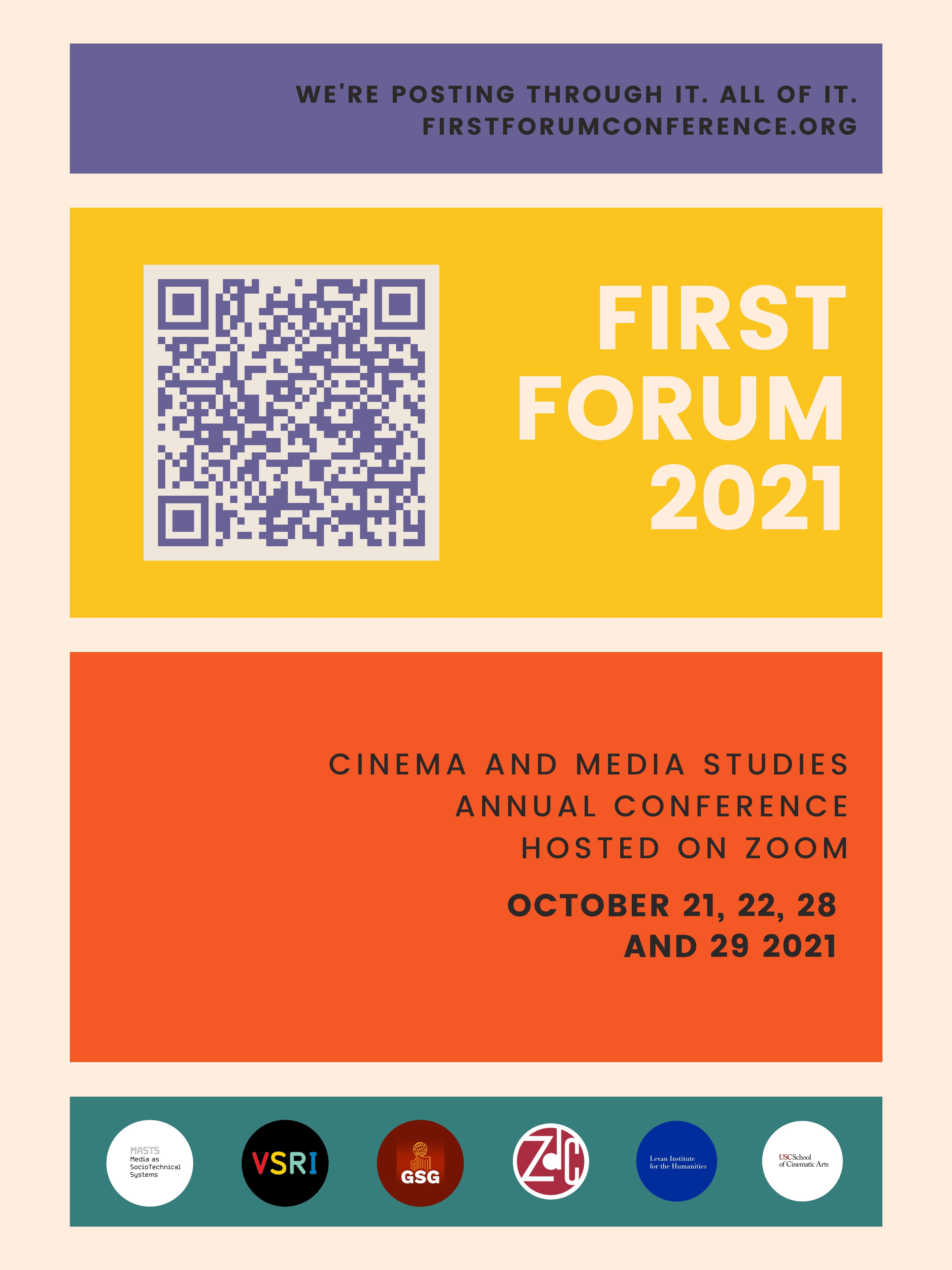
USC Cinema and Media Studies 2021 Graduate Student Conference [Oct. 21-22, 28-29]–

First Forum will be held virtually and the program schedule has panels and events spread out over two weeks on October 21, 22, 28, and 29. We have an exciting and dynamic set of speakers including our keynote speaker Dr. Bo Ruberg, an Associate Professor of Film and Media Studies at UC Irvine. Additionally, we will have a roundtable discussion featuring Dr. Erin Y. Huang, Dr. Camilla Fojas, and Dr. Ayesha Omer. You can find a full conference schedule on our website and through the QR code on the attached flyer. We look forward to seeing you there!

Amalia Amaki at the Photography Network Virtual Symposium [October 7-9, 2021]

Artist and scholar Amalia Amaki will be our Keynote for “The Material and the Virtual in Photographic Histories” (October 7-9, 2021). The First Symposium of the Photography Network will be held virtually, jointly hosted by the Photography Network and Folkwang University of the Arts, Essen. We are looking forward to our conversation with her on Thursday, October 7 at 4:00-4:45 pm UTC (12:00–12:45 pm EST) about her impressive art range and her ability to stretch the limits of photography’s materiality. The three-day symposium will pair previously recorded presentations (now available to registered attendees) with live roundtable discussions and Q&A sessions on October 7th, 8th, and 9th.

Registration is open and the presentation videos are live for the First Symposium of the Photography Network (October 7–9, 2021), a virtual event. Register now! Registration for this free event is now open. Symposium attendees are required to be current Photography Network members in good standing. Annual membership is $20 (student/unaffiliated), $40 (Affiliated), or $100 (Sustaining Member). Please visit the Photography Network’s website for more information on how to join. Once a member, link to the live sessions under the Account feature by clicking “Symposium_live (affiliated).”

CFP: New Scholars @ American Society for Eighteenth-Century Studies conference

ASECS 2022
52nd Annual Meeting
Hilton Baltimore Inner Harbor
March 31–April 2, 2022
Annual Meeting Website: https://www.asecs2022.org/

Anne Schroder New Scholars Session [Historians of Eighteenth-Century Art and Architecture]
Dipti Khera (New York University), dipti.khera@nyu.edu; and Aaron Wile (National Gallery of Art), A-Wile@nga.gov
This is an open session for advanced graduate students and early career scholars in the art and architectural history of the long eighteenth century around the globe. We especially encourage submissions from underrepresented scholars; those who work in universities, museums, and para-academic institutions outside of North America and/or in adjunct employment positions; and those who define their stakes, topics, and temporal frames for the eighteenth century through visual/material/spatial analyses in relation to histories of enslavement, colonization, and the racialization and discrimination of bodies, knowledge, places, and objects.
Proposals should be sent directly to the session chairs no later than 17 September 2021.

CFP: Black Collage @ CAA2022

caa.confex.com/caa/2022/webprogrampreliminary/Session9195.html
caa.confex.com/caa/2022/webprogrampreliminary/meeting.html

Black Collage
Session will present: Virtual

Julie L. McGee, University of Delaware
Email Address(s):mcgee@udel.edu

Black Collage, before and beyond Romare Bearden, respects the multivalent nature inherent to Black and Collage. How have and do artists and scholars participate in the un-doing of modernist tropes associated with a history of collage that displaced Black subjectivity and agency? Black collage may adhere to a practice of coller, in reference to the French verb which means to paste or glue, but in ways that don’t inherently bind this practice to European Modernism, Pablo Picasso or Georges Braque. Suppose coller hews more to adhesive than metaphor–that Black collage transcends pieces for compositional uniqueness, a symphony’s manuscript. Black American artists used collage before Bearden, yet there is no denying the centrality of his work to this conversation. Indeed, Bearden’s significance calls us to think deeply about the extended practice and importance of collage and Black artists. Among the many who have are Ralph Ellison, Kobena Mercer, Patricia Hills, James Smalls, Jacqueline Francis, Ruth Fine, and Brent Hayes Edwards. In early 1961, while living in Stockholm, Sam Middleton completed a treatise on collage that placed his own work in a direct line of inheritance from Picasso and Cubism to Surrealism and Dada—for its radical aesthetic refusals and nowness. Appropriating Shahn, Middleton wrote, “Art always has its ingredients of impudence, its rejection of established order so that it may substitute its own fresh and contemporary authority and its own enlightenment.” This session invites contributions related to Black collage, audacity and enlightenment. Considerations of history, theory, conservation, and artistic practice are welcome.

CFP: Nineteenth-Century Studies Association Conference

RADICALISM & REFORM
The 43rd Annual Conference
Nineteenth-Century Studies Association
Rochester, New York
March 16-19, 2022
Proposal Deadline: September 30, 2021

Conference Website: ncsaweb.net/conferences/2022-ncsa-conference-information/

Join NCSA’s mailing list: mailchi.mp/4b3379af336e/ncsamailinglist

Inspired by the history of radicalism and reform in Rochester, New York, the NCSA committee invites proposals exploring the radical possibilities of the nineteenth-century world. From the aftershocks of the French and American revolutions to mutinies and rebellion in colonies across the globe, the nineteenth century was a period of both unrest and possibility. Abolition, suffrage, and reform movements reshaped prisons, education, and housing, marking this century as a period of institutional making and unmaking: a reckoning with ills of the past that was also profoundly optimistic about a more just and prosperous future.

Radicalism is also a generative term for considering transitional moments or social tensions: “radical” is often used interchangeably with “extreme,” but its earliest definitions describe not what is new or unusual, but what is foundational or essential. “Radical” is used to describe literal and figurative roots: the roots of plants, roots of musical chords, and the roots of words. To be radical is to embody tensions between origins and possibilities: to be anchored in what is foundational while also holding the potential for paradigm-shifting change. We welcome papers that consider these tensions in nineteenth-century culture, as well as those that consider possibilities for reforming nineteenth-century studies or academic life. Topics on nineteenth-century literature, history, art, music, or other cultural forms might include political movements or divisions, activism, resistance, labor, collective and direct action, or mutinies and rebellion. We also encourage broader interpretations of the conference theme: outsiders and outcasts, visionaries, agents of change, utopias, breakthroughs, failed reforms, conformity, or stagnation.

Topics on the state of nineteenth-century studies might include politically engaged teaching and scholarship, academic labor practices, harassment or prejudice in the academy, or new approaches to humanities education.

For more information, visit: ncsaweb.net/conferences/2022-ncsa-conference-information/

CFP: Beyond In/visibility: the Politics of Asian American Representation in American Art History (for CAA Annual Conference 2022) –submit by Aug. 30, 2021

CFP for CAA Annual Conference 2022

Beyond In/visibility: the Politics of Asian American Representation in American Art History (Association of Historians of American Art [AHAA] Panel Session)

What are the consequences of asking for greater Asian American visibility in art history?

We are reckoning anew with our discipline’s intellectual and material priorities which have enforced racial-class-gender hierarchies and American imperialist and exceptionalist ideologies. Across museums and universities, immediate solutions call for increased inclusion and representation of marginalized peoples into existing historical canons. What are the limits of these correctives for peoples who have been dehumanized through aestheticization and surveillance throughout American history, and endangered because of their hypervisibility in everyday life? Now over 50 years since the term “Asian American” emerged as a disciplinary and political category, we must reflect on ways to narrate the specificities of the Asian diaspora within American academies and museums beyond the binaries of visible/invisible, inclusion/exclusion.

This panel invites ongoing research, curatorial case studies, and experimental methodologies that engage with issues such as: How has “Asian [United States] American” been a useful and limiting category for research, curation, and museum interpretation? What are strategies to present the historical absence or loss of Asian American subjects in archives and permanent collections? Are there ways to identify unconventional presence through creative citation or display practices? How might Asian American art histories attend to moments of solidarity and failure with respect to Black, Latinx, Indigenous and Pacific Islander communities and objects? How can Asian American art histories counter existing disciplinary priorities to aestheticize, visibly represent, visually clarify, expose, access, and possess its subjects—for example, through opacity, obscuration, dis-orientation, mistranslation, protective veiling?

Please submit by August 20, 2021

SYMP: Teaching the ‘Long’ 18th Century


https://virginia.zoom.us/webinar/register/WN_qPSWyVTlSzCdu6PkVWVUlw

James A. Porter Colloquium

Dear Supporters of the James A. Porter Colloquium:

We are pleased to announce that registration for the 31st Annual James A. Porter Colloquium is available at:
https://www.nga.gov/research/casva/meetings/porter-colloquium.html

The 31st Annual James A. Porter Colloquium on
African American Art and Art of the African Diaspora
“Defining Diaspora: 21st Century Developments in Art of the African Diaspora”
Friday, April 16, 2021, 4:30–6:00 p.m.

The 31st Annual James A. Porter Colloquium is co-presented by Howard University’s Department of Art, the Center for Advanced Study in the Visual Arts at the National Gallery of Art and the David C. Driskell Center for the Study of the Visual Arts and Culture of African Americans and the African Diaspora at University of Maryland, College Park. This year’s virtual program will explore the theme “Defining Diaspora: 21st Century Developments in Art of the African Diaspora.” Sessions will investigate the ways in which visual artists and scholars are defining, and redefining, the aesthetic contours and possibilities of the African Diaspora in American art spaces. Started in 1990 by art historian Dr. Floyd Coleman, the Porter Colloquium is the foremost academic setting for innovative dialogue and perspectives from leading and emerging scholars, artists, curators, and cultural critics.

The National Gallery of Art will live-stream presentations with online audience Q&A on Friday, April 16, 2021, 4:30-6:00 PM. Online registration is available at: https://www.nga.gov/research/casva/meetings/porter-colloquium.html

Generous programming support has been provided by the Robert Rauschenberg Foundation and Michael Rosenfeld Gallery.
James A. Porter Colloquium on African American Art and Art of the African Diaspora
This event brings together artists and art historians to explore the aesthetic practices, critical issues, and art historical interpretations of the art of the African Diaspora. To celebrate the centennial of Howard University’s department of art, we are honored to cosponsor this event.
www.nga.gov

2021 Porter Colloquium Honorees and Distinguished Speakers
Lifetime Achievement Awards
Renée Stout, artist

Freida High W. Tesfagiorgis, Evjue-Bascom Emerita Professor of African and African American Art History & Visual Culture, Departments of Afro-American Studies and Gender & Women’s Studies at the University of Wisconsin–Madison

James A. Porter Book Award
Travel and See: Black Diaspora Art Practices Since 1980, by Kobena Mercer, Professor, History of Art and African American Studies, Department of the History of Art, Yale University

Full Program of Events

The 19th David C. Driskell Center Distinguished Lecture in the Visual Arts Series in Honor of David C. Driskell, hosted by The David C. Driskell Center for the Study of the Visual Arts and Culture of African Americans and the African Diaspora, University of Maryland, College Park

Thursday, April 15, 6:00 PM EST           (Register at: https://driskellcenter.umd.edu/)

Prof. Curlee Holton, Director and Artist-in-Residence, David C. Driskell Center for the Visual Arts and Culture of African Americans and the African Diaspora

“What’s Next? David C. Driskell Artist/Scholar/Activist: A model for future role and practices of African American Artists”

Porter Colloquium Keynote Lectures, co-sponsored with the Center for Advanced Study in the Visual Arts at the National Gallery of Art, livestreamed on CASVA website, April 16, 4:30-6:00PM (Register at:  https://www.nga.gov/research/casva/meetings/porter-colloquium.html)

Porter Colloquium Opening Lecture
Erica Moiah James, Assistant Professor, Department of Art and Art History, University of Miami
“Undress to Redress: African Diasporic Art History and Archives of Black Representational Bodies”

Keynote Lecture
Freida High W. Tesfagiorgis, Evjue-Bascom Emerita Professor of African and African American Art History & Visual Culture, Departments of Afro-American Studies and Gender & Women’s Studies at the University of Wisconsin–Madison
            “Reflections on My Personal/ Professional Journey That Continues Amid Crises”

James A. Porter Distinguished Lecture
Kobena Mercer, Professor, History of Art and African American Studies, Department of the History of Art, Yale University
“Flowback—How Africa is Redefining Today’s Diaspora”

Floyd Coleman Distinguished Lecture
Renée Stout, artist
           “Thank You for Talking to Me Africa: Trusting the Voice Within”

Artist Conversations (Available on Howard University Gallery of Art Porter Colloquium Website after 4/16; no registration necessary)

Willis “Bing” Davis in conversation with Akili Tomassino (Associate Curator, Modern and Contemporary Art, Museum of Fine Arts, Boston)

Aïda Muluneh and Larry Cook (Assistant Professor of Photography, Department of Art, Howard University) in conversation with Natalie Hopkinson (Associate Professor, Department of Communication, Culture and Media Studies, Howard University)

Please register and join us on April 15th and April 16th, 2021.