Category: publications
PUB: Slavery & Abolition: A Journal of Slave and Post-Slave Studies – Volume 33, Issue 2
Section of particular interest:
In Plain Sight: Breaking the Textual Bind
Celeste-Marie Bernier, ‘A “Typical Negro” or a “Work of Art?” The
“inner” via the “outer man” in Frederick Douglass’s Manuscripts and
Daguerreotypes’
Fionnghuala Sweeney, ‘Visual Culture and Fictive Technique in
Frederick Douglass’ The Heroic Slave’
Lisa Merrill, ‘Exhibiting Race “Under the World’s Huge Glass Case”:
William and Ellen Craft and William Wells Brown at the Great
Exhibition in Crystal Palace, London, 1851’
CFP: Journal of Art Historiography Special Issue on African Art
The *Journal of Art Historiography*, a peer reviewed journal (http://arthistoriography.wordpress.com),
is interested in producing a special issue on African art.
The discursive practice of African art history is at a crucial juncture, in which rising interest in African art from a global perspective intersects with a possible fragmentation of the field into divergent disciplines each with its own focus. The historiography of African visual arts itself confronts an cross-disciplinary problem identified by *Journal of Art Historiography* as a concern that “contemporary scholarship will forget its earlier legacy and neglect the urgency and rigour with which those early debates were conducted. The journal is therefore committed to studying art historical scholarship, in its institutional and conceptual foundations, from the past to the present in all areas and all periods”.
African art history is particularly in need of this historiographical examination, given the increasing distance between early scholarship and contemporary discourses. The last significant historiography of the field was carried out by the venerable Monni Adams in a classical essay titled “African Visual Arts from an Art Historical Perspective (*African Studies Review*, 32/2, 1989: 55-103), which formed a two part overview of African Studies published in journal, the other written by Paula Ben Amos.
Although African Arts has engaged the issue of African art’s discourse in various presentations in the journal to date, the kind of comprehensive analysis carried out by Monni Adams has largely been absent and is in dire need of
being updated, given how much has happened in the field in the two and half decades since the article was published. The *Journal of Historiography*’s special issue on African arts therefore provides a unique opportunity to revisit the history of art writing on the subject of African visual culture and create a critical dialogue between various generations of African art historians, which will ideally allow foundational research and writing to be subjected to contemporary knowledge practices.
I have been asked to serve as guest editor this proposed issue. I will like to invite proposals for articles on the subject and also appeal to the field to suggest important texts and documents that might be included in this special issue. Previous editions of the journal can be viewed on its website (http://arthistoriography.wordpress.com) for guidance on the Journal of Art Historiography’s focus and submission guidelines.
Please send proposals and suggestions to:
Prof. Sylvester Okwunodu Ogbechie
ogbechie@gmail.com
Guest Editor, *Journal of Art Historiography* Special Issue on African art
PUB: THIN BLACK LINE(S)
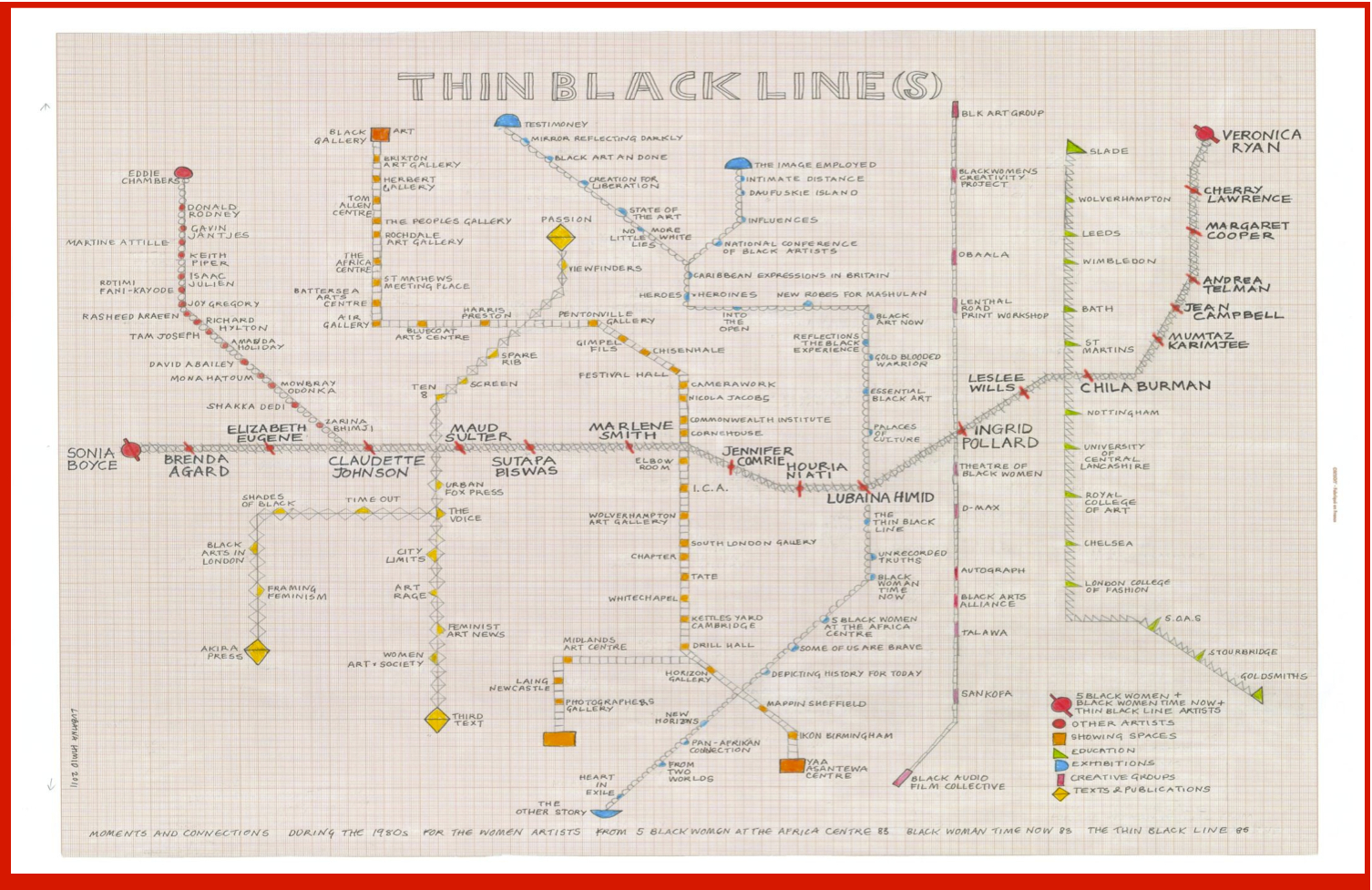
Lubaina Himid, Thin Black Line(s): Moments and Connections During the 1980s for the Women Artists (2011)
The exhibition Thin Black Line(s) closed at Tate Britain in March, but the exhibition catalog is an invaluable record of the show’s commemoration of “Black British art” in the 1980s. The catalog reproduces the work of Sutapa Biswas, Sonia Boyce, Lubaina Himid, Claudette Johnson, Ingrid Pollard, Veronica Ryan, and Maud Sulter; it also includes archival material documenting that decade of creative and progressive political alliances among these artists of African, Asian, and Caribbean descent. ISBN 978-0-9571579-0-3
CFP: Inaugural Issue: Journal of Critical Mixed Race Studies
“Emerging Paradigms in Critical Mixed Race Studies”
The Journal of Critical Mixed Race Studies (JCMRS) is a peer-reviewed online journal dedicated to Critical Mixed Race Studies (CMRS). Launched in 2011, it is the first academic journal explicitly focused on Critical Mixed Race Studies. Sponsored by UC Santa Barbara’s Sociology Department, JCMRS is hosted on the eScholarship Repository, which is part of the eScholarship initiative of the California Digital Library. JCMRS functions as an open-access forum for critical mixed race studies scholars and will be available without cost to anyone with access to the Internet.
JCMRS is transracial, transdisciplinary, and transnational in focus and emphasizes the critical analysis of the institutionalization of social, cultural, and political orders based on dominant conceptions and constructions of race.
JCMRS emphasizes the constructed nature and thus mutability of race and the porosity of racial boundaries in order to critique processes of racialization and social stratification based on race. JCMRS addresses local and global systemic injustices rooted in systems of racialization.
Some questions to consider:
• Why Critical Mixed Race Studies rather than mixed ethnicity or mixed heritage?
• How does CMRS transform Ethnic Studies?
• What does CMRS mean in transnational contexts?
• What are some ways that CMRS can be institutionalized?
• How do foundational articles or books in CMRS resonate today?
• How does CMRS relate to the Multiracial Movement or social activism around mixed heritage identities?
• How does post-racial discourse factor into the development of CMRS?
• How is CMRS transdisciplinary or interdisciplinary?
Papers that were presented at the Inaugural Critical Mixed Race Studies Conference in 2010 are invited for revision and submission. JCMRS encourages both established and emerging scholars to submit articles throughout the year. Articles will be considered for publication on the basis of their contributions to important and current discussions in mixed race studies, and their scholarly competence and originality.
Submission Deadline: July 1, 2012
Submission Guidelines: Article manuscripts should range between 15-30 double-spaced pages, Times New Roman 12-point font, including notes and works cited, must follow the Chicago Manual of Style, and include an abstract (not to exceed 250 words).
Visit our website for complete submission guidelines and to submit an article:
http://escholarship.org/uc/ucsb_soc_jcmrs
Please address all inquiries to: socjcmrs@soc.ucsb.edu
CFP: African and its diasporas @ n.paradoxa: international feminist art journal
CALL FOR PAPERS
n.paradoxa: international feminist art journal
Volume 31: Africa and its diasporas (Jan 2013)
Guest Editor: Bisi Silva, independent curator and Director CCA, Lagos
(Copy deadline: 15 October 2012, to be published Jan 2013)
In the last two decades, there has been an exponential growth in the visibility of a new generation of women visual artists on or from the continent of Africa as well as a diversification not only in the medium but also in the breadth and complexity of the themes and issues with which they engage, which include the body, sexuality as well as questions of history, culture, patriarchy and post-colonialism. The aim of the volume is to look at women artists’ production across the over 50 countries that make up the continent of Africa as well as at African women artists working in Europe, South and North America and the Caribbean. The African diaspora is diverse stretching across the Atlantic to the Caribbean, the Americas and across Europe.
Women artists from Africa, and of African descent, have been producing work which questions and challenges both their contemporary situation and their complex histories. This special volume will publish work which addresses these concerns and focuses on the cultural production of women artists who define themselves as black/African/Afro-Caribbean/Afro-American across the globe as well as first/second/third/and even fourth generations of immigrants in different countries. Contributions about contemporary art produced by women which reflect on the effects of the migration of African people around the world – during and after slavery – during and after Colonialism –pre- and post-1960s Independence – will be welcomed.
Critical essays as well as in-depth interviews offering a pan- or trans-African perspective on contemporary women artists (visual arts only, post-1970) will be welcomed from women artists or writers (art historians, critics and curators). We invite 300-400 words abstract by the 11th of June 2012 (Final contributions by Oct 15th 2012)
For more information about how to contribute please email Bisi Silva labisi22@gmail.com
About n.paradoxa
international feminist art journal
Founded in 1998, n.paradoxa publishes scholarly and critical articles written by women critics, art historians and artists on the work of contemporary women artists post-1970 (visual arts only) working anywhere in the world. Each thematic volume in print contains artists and authors from more than 10 countries in the world and explores their work in relation to feminist theory.
n.paradoxa is published bi-annually (January and July) in print as volume numbers (ISSN: 1461-0424). n.paradoxa is now available for sale in print and electronic forms by subscription. KT press is the publisher of n.paradoxa and operates as a not-for-profit publishing company whose aim is to promote understanding of women artists and their work.
Website: www.ktpress.co.uk
Martin Berger talks about his 2011 book, SEEING THROUGH RACE
http://www.youtube.com/watch?v=nEDnom7xma4
Professor Berger’s lecture at the California College of the Arts (San Francisco campus), November 17, 2011.
Professor Berger’s lecture at the California College of the Arts (San Francisco campus), November 17, 2011.
New Book: The Future Is Now: A New Look at African Diaspora Studies
3rd Edition of Journal: SAVVY | art.contemporary.african.

Out Now: 3rd Edition of SAVVY Journal for Critical Texts on Contemporary African Art
SAVVY | art.contemporary.african. (ISSN 2191-4362)
 Title: Art and politics – An inseparable couple? The fire behind the smoke called political art.
Talking about politics and Africa is always crackling. Talking about politics and art is always a guarantee for a hot debate. Then of course talking about art, politics and Africa is a recipe for an electrifying discourse. An objective and constructive critique without pledging any predetermined allegiance to a specific school of thought is an important ingredient in this recipe.
What is for certain is, arts and politics are not of different planets. They share the same playground, they are not antagonistic but complementary to each other and usually co-exist in a symbiotic relationship… and that was evident in many of the texts we received. Surprisingly, we received no article claiming the independence of…
View original post 364 more words
 ACRAH
ACRAH 