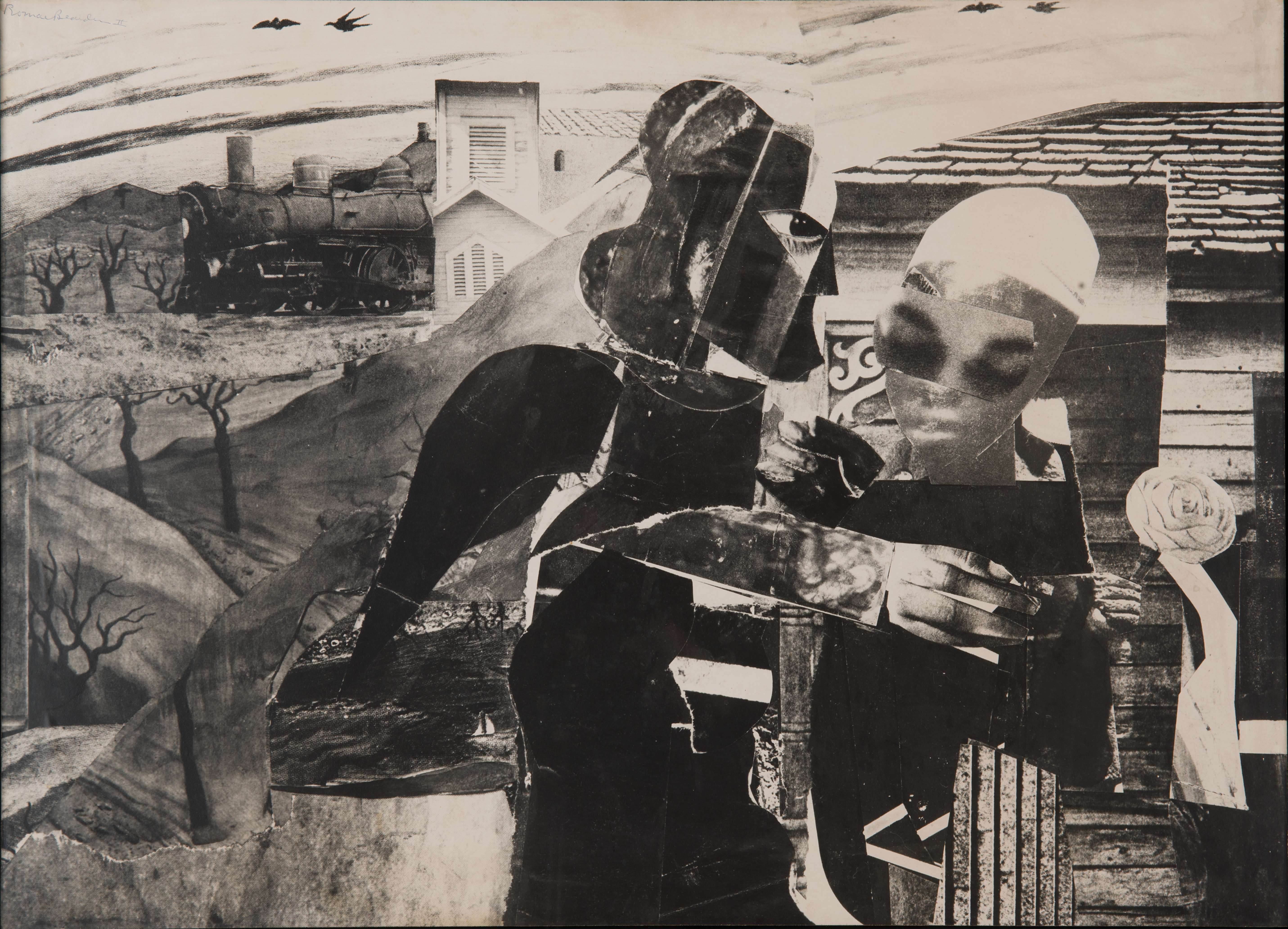
The Wildenstein Plattner Institute is proud to announce the inaugural release of THE ROMARE BEARDEN CATALOGUE RAISONNÉ PROJECT, featuring over 200 of the artist’s unique works created between 1964 and 1969. This significant launch represents a major step forward in the study of one of the 20th century’s most influential African American artists.
Working in partnership with the Romare Bearden Foundation, WPI’s team of researchers led by Dr. Camara Holloway have made incredible strides in identifying elements of the artist’s production: approximately 50 works presented in this first installment were previously unknown within the Foundation’s records.
The publication of this first installment includes an introductory text by Jacqueline Francis and Anne Monahan, “Romare Bearden, 1964–69: A Turning Point,” which describes Bearden’s artistic transformation — from painter and watercolorist to a nationally-recognized master of collage — as well as pivotal moments earlier in his career: http://bit.ly/4neTiox
We are thrilled to share the initial phase of this project with the larger community, and are looking forward to future installments with continued collaboration with the Romare Bearden Foundation, our technology partner Navigating.art and vital support from the Hasso Plattner Foundation.
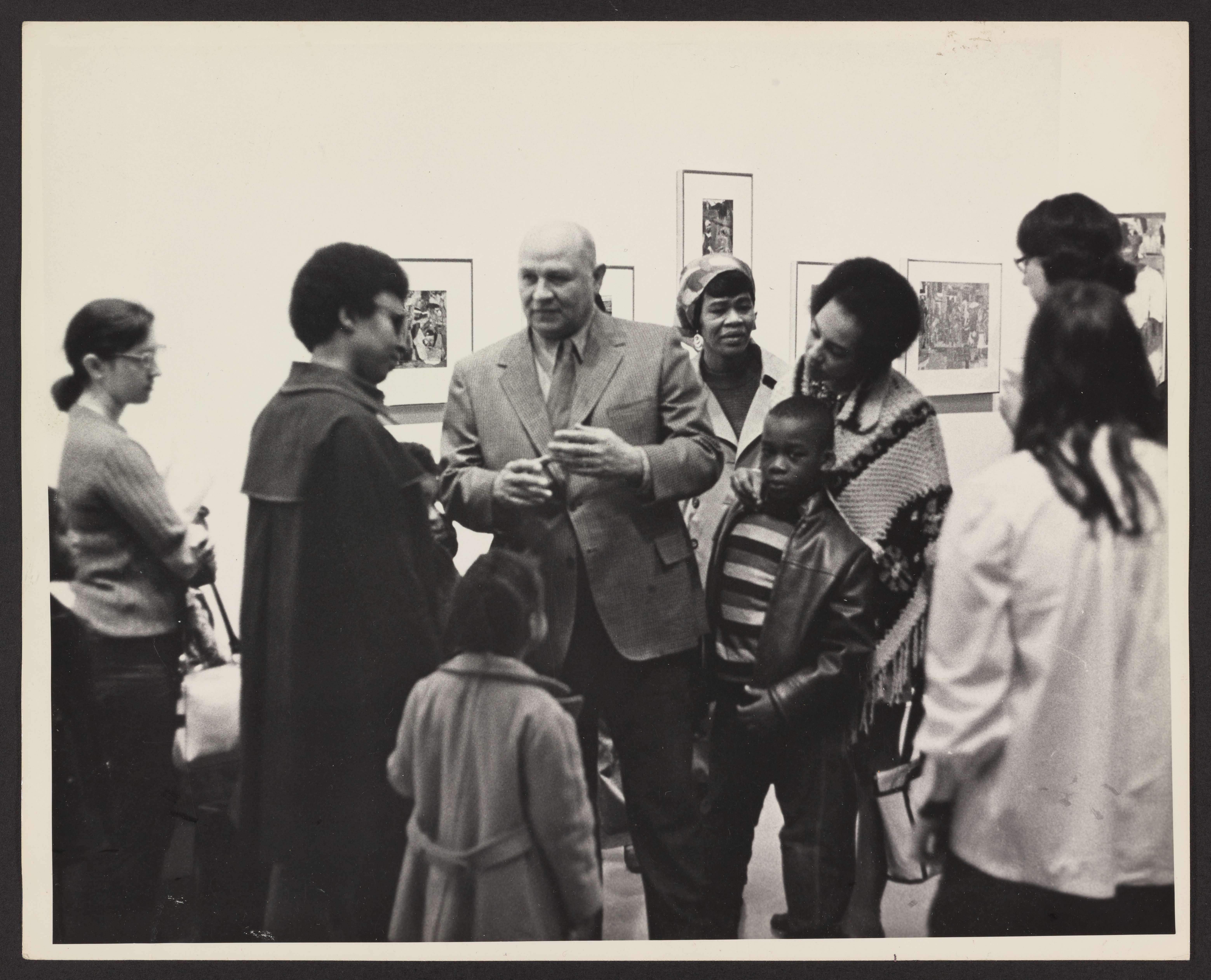
Bearden with Betty Blayton and Children’s Art Carnival students; “Romare Bearden: The Prevalence of Ritual” at the Studio Museum in Harlem, 1972; Romare Bearden Papers [ysqdockk], The Wildenstein Plattner Institute, Inc.
We hope you can join us for an exciting series running throughout May 2024 hosted by the Wildenstein Plattner Institute:
ENDURING LEGACY: Conversations on Romare Bearden
This event series features three speakers whose scholarship and practice engage with Bearden’s formulation of the visual world.
Charlie Farrell will discuss the exhibition Romare Bearden: Resonances at the Saint Louis Art Museum. The show features Bearden’s important collage, Summertime (1967), alongside other collage works from the Museum’s collection. The aim is to trace Bearden’s influence and relationships with other artists, grounding him in a continuum of Black creativity.
Anne Monahan will discuss her chapter on Bearden from her manuscript in progress, “A Usable Past”: Race, Figuration, and Politics in the 1960s. Her research on Bearden reconsiders his breakthrough Projections exhibition in 1964, exploring his turn to photomontage, how race factored into the works’ reception, and the impact of this work on a rising generation of artists of color.
Conceptualizing Black Joy with Kahlil Robert Irving
Kahlil Robert Irving will discuss his artistic practice, including the pieces that were included in the recent exhibition, In Common: New Approaches with Romare Bearden, held at the New School in New York City. The show featured the work of six contemporary artists alongside that of Bearden.
These conversations commemorate Bearden’s continuing impact thirty-six years after his passing. The insight of his work resonates with our present moment and contemporary questions of race in America. More information can be found on our website.
The 1960s was a tumultuous moment in American history as racial equality movements propelled sweeping changes to the body politic. This critical juncture in the nation’s race relations captured the public’s attention as the media delivered the unfolding drama to their doorsteps. The turbulent racial climate spurred the artist’s Romare Bearden’s pivotal turn to collage and return to Black figuration.
This webinar series presents new insights into the work of Bearden and his contemporaries. His fellow artists, who came from diverse racial backgrounds, joined Bearden in responding to the tenor of the times and tackling Black subject matter and/or racial themes in their work. The series will expand our understanding of how racial concerns were articulated during this watershed decade.
About the Webinars:
Tomorrow I May Be Far Away — with Bridget R. Cooks
In this talk, art historian Bridget R. Cooks addresses Romare Bearden’s ability to engage the Black and mainstream art worlds during the 1960s and ’70s. During this time, his art was revered as exemplary of American art and Black art in different institutional contexts delineated by race. Cooks discusses how Bearden navigated his presence in both worlds through his art and exhibitions.
Bridget R. Cooks is a scholar and curator of American art. She serves as Chancellor’s Fellow and Professor of African American Studies and Art History at the University of California, Irvine. She is most well-known as the author of the book, Exhibiting Blackness: African Americans and the American Art Museum.
Romare Bearden, the South, and the Southern Black Arts Movement— with James Smethurst
This talk will discuss the place of the South, what Romare Bearden described as the “homeland of my imagination” in Bearden’s work. It will also consider the impact of Bearden and his work on the Black Arts Movement in the South during the 1960s and 1970s.
James Smethurst is a Professor of Afro-American Studies at the University of Massachusetts Amherst. He is the author of The New Red Negro: The Literary Left and African American Poetry, 1930-1946; The Black Arts Movement: Literary Nationalism in the 1960s and 1970s;The African American Roots of Modernism; Brick City Vanguard: Amiri Baraka, Black Music, Black Modernity; and Behold the Land: A History of the Black Arts Movement in the South.
Bearden and Harlem in the 1960s — with Maya Harakawa
This talk explores Romare Bearden’s evolving relationship with Harlem in the 1960s, a decade when Bearden depicted Harlem in his art, joined the neighborhood’s cultural council, curated exhibitions in Harlem, and protested reductive curatorial approaches to Harlem’s history. In addition to discussing Bearden, the talk will also focus on the artistic landscape of 1960s Harlem and highlight the neighborhood’s role in defining artistic practice at a moment of profound social and artistic change.
Maya Harakawa (she/her) is assistant professor of art history at the University of Toronto. A specialist in art of the African Diaspora in the United States, she is currently writing a book on art and Harlem in the 1960s.
Witness: Rauschenberg Reflects the Tumultuous 1960s — with Helen Hsu
Deploying methods of collage, innovated with solvent transfer and screenprinting techniques, Robert Rauschenberg (1925–2008) appropriated from, intervened in, and disrupted the ever proliferating mass media imagescape. “Witness” presents examples of the artist’s work from the 1960s that crystallize the decade’s cultural reckonings and historical crises. Rauschenberg’s remaking and reinvention of collective visual sources invites viewers to critically engage with shifting conditions of recognition and obscurity, recasting the encounter with an artwork as a form of creative participation.
Helen Hsu is the Associate Curator for Research at the Robert Rauschenberg Foundation. She was formerly an assistant curator at the Solomon R. Guggenheim Museum and is an alumna of Stanford University.
“Revisiting the Spiral Group,” will be hosted by the Romare Bearden Foundation on Thursday, July 27th, at 6pm EST on Zoom. The event commemorates the 60th anniversary of the founding of Spiral, an African American artists’ collective co-founded by Romare Bearden, Charles Alston, Norman Lewis, and Hale Woodruff.
A conversation with Richard Mayhew, the oldest living member of Spiral, and Courtney J. Martin, the director of the Yale Center for British Art will be moderated by Camara Holloway, project manager for the Romare Bearden catalogue raisonné at the Wildenstein Plattner Institute and ACRAH co-director.
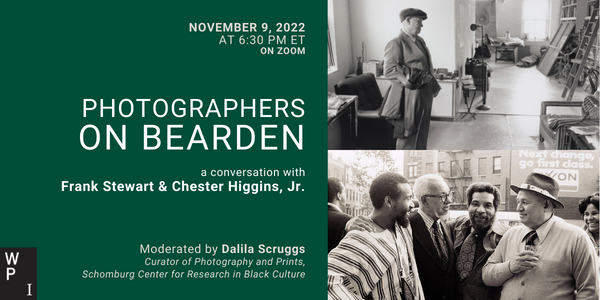
Join renowned photographers Frank Stewart and Chester Higgins, Jr., in a conversation moderated by Dalila Scruggs, Curator of Photography and Prints at the Schomburg Center for Research in Black Culture, who will discuss their relationship with the acclaimed African-American artist, Romare Bearden, and their experiences photographing African-American artists and culture over the years.
This event celebrates the initial release of the Romare Bearden Papers by the Wildenstein Plattner Institute (WPI). The WPI has worked closely with the Romare Bearden Foundation to make the artist’s archival collection accessible to the public in anticipation of the forthcoming Romare Bearden Digital Catalogue Raisonné.
Frank Stewart shot his first photographs at the 1963 March on Washington and has gone on to make compelling images ever since. Stewart earned a BFA in photography from Cooper Union in 1975 and counts Roy DeCarava, Garry Winogrand, Jack Whitten, and Romare Bearden amongst his mentors. Stewart was the first photographer-in-residence at The Studio Museum in Harlem, where he also taught photography. He has been a member of Kamoinge, Inc. since 1982, and was the lead photographer for Jazz at Lincoln Center almost three decades. Stewart is widely published, has had more than thirty solo exhibitions and is the recipient of numerous prestigious awards. His work is held in the collections of major museums including Bowdoin College Art Museum, Brunswick, Maine, the Detroit Institute of Arts; George Eastman House, Rochester, New York, the High Museum of Art, Atlanta, the Museum of Modern Art, New York, the National Museum of African American Art and Culture, Washington, DC, and the Studio Museum in Harlem, New York. Stewart is the subject of an upcoming retrospective titled, Nexus: An American Photographer’s Journey, 1960’s to the Present, that opens at the Phillips Collection in Washington, DC, in June 2023.
Chester Higgins Jr. is a photographer known for his eloquent images of the life and culture of African Americans and the people of the African Diaspora. He counts P. H. Polk, Arthur Rothstein, Cornell Capa, Gordon Parks and Romare Bearden amongst his mentors. He was a staff photographer for the New York Times from 1975 to 2014. Widely published, his photographs have appeared in magazines including Ebony, Essence, Fortune, LIFE, Look, Newsweek, and TIME, and in several books including Sacred Nile, Echo of the Spirit and Elder Grace. His work has appeared in numerous solo exhibitions, most recently The Indelible Spirit at the Bruce Silverstein Gallery. He has received fellowships and grants from the International Center of Photography, The Ford Foundation, The National Endowment for the Arts and the Rockefeller Foundation. His photographs are included in the following permanent collections: The Museum of Modern Art, New York, the Museum of Modern Art, San Francisco, the Virginia Museum of Fine Art, Richmond, the Library of Congress, and the Schomburg Center for Research in Black Culture, New York.
Dalila Scruggs is Curator for Photography and Prints at the Schomburg Center for Research in Black Culture. She earned a Ph.D. in Art History from Harvard University, where she focused on African American art. She has held curatorial positions at the Williams College Museum of Art and the Brooklyn Museum, and served as the Brooklyn Museum’s Museum Education Fellowship Coordinator.
… The Wildenstein Plattner Institute, Inc. (WPI) is a non-profit foundation dedicated to the study of art history and to fostering the accessibility, cataloguing, and digitization of archival materials that support critical research in the field.

 ACRAH
ACRAH 