Author: Camara Dia Holloway
I am the Project Manager for the Romare Bearden Digital Catalogue Raisonné at the Wildenstein Plattner Institute. I earned my PhD at Yale University in the History of Art Department and specialize in twentieth century American art with a particular focus on the history of photography, race and representation, and transatlantic modernist networks. I also serve as a Founding Co-Director of the Association for Critical Race Art History (ACRAH).
EXH: “Disillusions, Gendered Visions of the Caribbean”
INT: ‘The African Diva Project’
Interview with Margaret Vendryes about the exhibition of “The African Diva Project” on the blog divaMissioN:
http://www.divamission.com/2011/09/divafeature-african-diva-project.html#more
also check out Vendryes’ website http://www.margaretrosevendryes.com
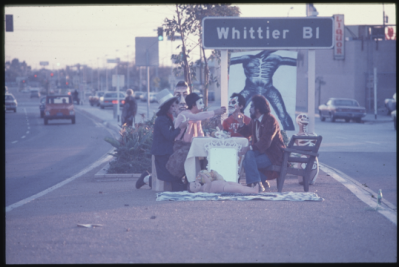
Asco, Firsthand (via Unframed The LACMA Blog)
LEC: Transdisciplinary Seminar on Afrofuturism Lecture Series @ Parsons
The Transdisciplinary Seminar on Afrofuturism will explore how representations of science, technology and social engineering intersect with visual cultural expressions of the African diaspora. Science fiction is the organizing trope that will unite all the guest presentations and works under consideration. Visiting artists and cultural theorists will lecture on the role of futuristic projection in African diasporic art, liteature, film and music. The expediency of science fiction as both a fractured mirror of historical experience and a projection of the collective desires of a displaced people will be discussed throughout the semester.
The Transdisciplinary Seminar on Afrofuturism features seven public lectures by guest artists and cultural theorists in the fall of 2011. These lectures are open to the public and will take place on Tuesdays at 6pm. The public lectures that are part of this seminar are produced with support from The Robert Lehman Foundation.
http://amt.parsons.edu/2011/08/26/transdisciplinary-seminar-on-afrofuturism-lecture-series/
Recent Works by David Hammons at LACMA (via Unframed The LACMA Blog)

SYMP: Indigenous Visions: Rediscovering the World of Franz Boas @ Yale
Indigenous Visions: Rediscovering the World of Franz Boas.
Indigenous Visions:
Rediscovering the World of Franz Boas
Thursday, September 15, 2011
Beinecke Library
Friday and Saturday, September 16-17, 2011
Luce Hall Auditorium, 34 Hillhouse Avenue
Yale University
New Haven, Connecticut
CFP: Otherwise Engaged @ University of Leeds
An interdisciplinary postgraduate symposium
3 December 2011
School of Fine Art, History of Art and Cultural Studies, University of Leeds.
Keynote Speaker, Prof. Lubaina Himid, International artist and curator, University of Central Lancashire
Call for Papers Deadline 15th September 2011
In 1995 Kobena Mercer published the first in his Annotating Art’s Histories edited series, Cosmopolitan Modernisms. In his introduction, Mercer stated that the series would offer:
‘[A] fresh approach [to art history] by showing how a shared history of art and ideas was experienced differently around the globe … In a situation where the aspiration to be all inclusive has become the official watchword of institutional policy, has the very idea of ‘inclusion’ now become a double-edged sword?’
In 2011, as a developing generation of artists, curators, art historians and academics enter the field of visual arts, this symposium at the School of Fine Art, History of Art and Cultural Studies, University of Leeds, seeks to investigate how we are to engage with the challenges of a shared and plural art history that Mercer, and so many others, speak of. What is the meaning of ‘inclusion’ today, sixteen years after Mercer’s publication? The symposium hopes to explore the numerous ways in which issues of race, culture, class, sex and gender have been considered across the various arenas of visual art, and how this emerging generation of those operating in the visual arts engage with the existing challenges of the past, present and future.
Otherwise Engaged is a one-day symposium that invites postgraduate students to submit proposals that consider the challenges of intervention, integration, separatism, confrontation, assimilation, ghettoisation and accommodation. How have marginalised spaces and mainstream institutions engaged with these challenges? We are interested in exploring the processes, relationships and pluralities of the various sites of the marginal and the mainstream. What are the experiences and examples of specific interventions, theoretical strategic models, and tactical approaches from contemporary art practice and writing, culture, education and curating?
Otherwise Engaged is an interdisciplinary event that crosshatches experiences, perspectives and analyses from art history, fine art, cultural studies, museum and curatorial studies, feminist studies, gender studies, sociology and post/colonial studies, although papers from other disciplines are also welcome. While the symposium is situated in contemporary Britain and the complexities of representation and identity internal to Britain, we strongly encourage the exploration of relationships with other sites, both geographically and generationally.
We invite abstracts of a maximum length of 300 words by 15 September 2011 (20 minute papers). You will receive confirmation of acceptance of the proposed presentation by October 1, 2011. You will need to submit your proposal together with a completed form available from the conference organisers – contact espencermills@yahoo.com.
CFP: Association for Asian American Studies 2012 Conference @ Wash, DC
http://www.aaastudies.org/2012/call/
Washington, DC April 11-14, 2012
Submissions due by Saturday, October 1, 2010
EXPANDING THE POLITICAL: POWER, POETICS, PRACTICES
The theme, “Expanding the Political: Power, Poetics, Practices,” refers to the location of the meetings in Washington, DC, the seat of politics and power in the United States. Asian Americans play an increasing role in U.S. and international politics in their roles as voters, politicians, and policy makers. At the same time, we wish to highlight the everyday and informal political practices of Asians in America as they use art, academics, and activism to engage—and change—the world around them. We invite submissions that address formal politics and informal politics in their multiple dimensions.
We welcome presentations that explore traditional conceptions of “politics” and political action on topics such as electoral politics, Asian Americans in the government, activism and social movements, and political interests and issues. Do Asian Americans constitute a political block (or have they ever)? How can we interpret the increasing presence of Asian American Republican politicians? Is “Asian America” a useful political category? Simultaneously, we hope the conference will expand our conception of the political to other areas including, but not limited to, the politics of: commemoration and memorialization; war and peace; dynamics within/across/outside Asian American communities, communities of color, and multiracial Asians; immigration, refugee status, citizenship, and national belonging; the relationship between Pacific Island Studies and Asian American Studies; Asian settler colonialism; empire and race. What generative political work emerges in the conversation between academics, activists, and artists? How do Asian Americans contend with the politics of the everyday? The overarching emphasis for this meeting is the analysis of power in its various manifestations in Asian American lives.
We encourage submissions representing all the disciplines covered in Asian American Studies and from individuals engaged in political work, broadly speaking, outside the academy, including politicians, artists and activists. We especially encourage panels incorporating a range of institutional and extra-institutional locations, from students to senior scholars, and from painters to policy makers. Complete panel submissions (with a minimum of three papers and a maximum of four, with a moderator) that attend to the conference theme and reflect this heterogeneity will be given priority, but we will consider individual submissions as well.
In addition to panels, workshops, and roundtables, this year we introduce an inaugural invitation for chaired WORKING PAPER sessions dedicated specifically to this year’s conference theme. For these sessions, panelists will submit longer papers (15-25 pages) prior to the conference, and sessions will be devoted to intensive commentary and discussion on a set of 2-3 papers with a shared theme. A faculty expert on the theme will chair each session and deliver detailed feedback to each author. This format will foster a deeper scholarly exchange and engagement, and showcase the common intellectual threads that run through our diverse research projects. We encourage scholars from various ranks to submit their papers to the Working Paper sessions.
We accept electronic submissions. Paper and panel applicants must be members of the Association for Asian American Studies and all presenters must register and submit their conference fee to be included in the printed conference program. Please check the “WORKING PAPERS” box if you would like your paper or panel submission to be considered for the Working Papers chaired sessions. Relevant information, including the membership form and submissions guidelines, is available at the Association for Asian American Studies Web site at http://www.aaastudies.org/forms
We look forward to seeing you at the 2012 Association for Asian American Studies conference in Washington, DC!
Committee Co-Chairs,
Sylvia Chong and Nitasha Sharma
*All paper and panel applicants must be members of AAAS in order to submit conference proposals. AAAS membership number or confirmation of membership from JHUP will be required with all proposals.
**AV equipment will be available on request but on a limited, first-come-first-served basis due to budget restrictions. Please make your requests when sending in your proposals.
JOB: Murphy Professor of Art History @ U Kansas
THE UNIVERSITY OF KANSAS
Kress Foundation Department of Art History
Judith Harris Murphy Distinguished Professor in Art History
(Open specialization)
Nominations and applications are invited for this endowed chair. The Murphy Professor will join a large and diversified department with an established PhD program and rich undergraduate curriculum. The University of Kansas, with more than 27,000 students and 1,500 faculty on the Lawrence campus, is the major educational and research institution in the state. The university has a full complement of 15 art and architectural historians in Asian and Western art. Endowments support active visiting lecturer programs, teaching initiatives, and research travel for faculty and doctoral candidates. The department is located in the Spencer Museum of Art, the collections and exhibitions of which provide a foundation for introductory and graduate course work. The Murphy Library of Art and Architecture, with holdings of over 170,000 volumes, and a large visual resources collection offer essential support of research and instruction.
The Murphy Professor will exercise leadership in research, teach undergraduate and graduate courses, and supervise theses and dissertations. S/he is expected to promote interaction among scholars in related fields and to provide service to the department, the university and the profession. The position will be awarded with tenure and is endowed with substantial research support; a reduced teaching load is expected to yield substantial and continuing research productivity.
The search is open to any art historical specialization. Candidates should have a distinguished international reputation for research and publication in their area of specialization. They should be significantly engaged in other professional activities and provide evidence of outstanding teaching abilities. It is expected that candidates should be tenured professors or have equivalent credentials. Women, minorities, and candidates who will contribute to the climate of diversity in the university, including a diversity of scholarly approaches, are especially encouraged to apply.
The University of Kansas is especially interested in hiring faculty members who can contribute to four key campus-wide strategic initiatives: (1) Sustaining the Planet, Powering the World; (2) Promoting Well-Being, Finding Cures; (3) Harnessing Information, Multiplying Knowledge; and (4) Building Communities, Expanding Opportunities. See http://www.provost.ku.edu/planning/themes/ for more information.
Salary: Commensurate with experience; substantial research support.
Starting Date: expected to begin as early as 18 August 2012
First consideration will be given to completed applications received by October 17, 2011, and will continue until the position is filled.
Go to https://jobs.ku.edu, search for position 00003119, and complete the application. Upload cover letter, CV, and names and contact information for three references. Nominations and inquiries should be addressed to Prof. Linda Stone-Ferrier, Chair, Murphy Search Committee, Kress Foundation Department of Art History, Spencer Museum of Art #209, University of Kansas, 1301 Mississippi Street, Lawrence, KS 66045. Email: LSF@ku.edu. EO/AA Employer.

