Webinar: “Hidden Histories: Rediscovering the Federal Art Project at the Saint Louis Art Museum”

Greetings,  

I’m writing to announce the free Living New Deal webinar “Hidden Histories: Rediscovering the Federal Art Project at the Saint Louis Art Museum” at 5 PM Pacific Standard Time on Tuesday, February 4, 2025.

To register, click on the link below

We invite you to join us for a webinar with John Ott, Professor of Art History at James Madison University, and Amy Torbert, the Andrew W. Mellon Foundation Associate Curator of American Art at the Saint Louis Art Museum and co-curator of the current exhibition The Work of Art: The Federal Art Project, 1935–1943. Their conversation will offer a behind-the-scenes look at the planning process for this show, relate forgotten and untold stories from our nation’s artistic past, and illuminate neglected contributions from women, immigrant, and minority artists.

Co-curated with Clare Kobasa, SLAM’s associate curator of prints, drawings, and photographs, The Work of Art presents a remarkable collection of artworks created amidst the hardship of the Great Depression. In 1934, President Franklin D. Roosevelt launched a series of national initiatives for the visual arts as part of the New Deal. The largest and most ambitious program, the Federal Art Project (FAP) (1935–43), put more than 10,000 artists on the federal rolls. The resulting artworks decorated municipal spaces, toured the nation in travelling shows, and eventually found homes in institutions across the country.

When the FAP ended in 1943, the Saint Louis Art Museum received a trove of 256 prints, drawings, watercolors, and paintings. This exhibition draws from this rich collection to explore how this federal program expanded opportunities to create and encounter art in many different communities, some of which had historically lacked the necessary infrastructure and support for the arts. By displaying work made by African American, Asian American, female-identifying, and immigrant artists, The Work of Art testifies to and keeps alive the New Deal’s ambition to nourish individuals and communities of every kind through the arts. Organized by geography, this showcase also reveals the complexities of the nation’s creative landscapes and art’s capacity to bridge communities near and far.
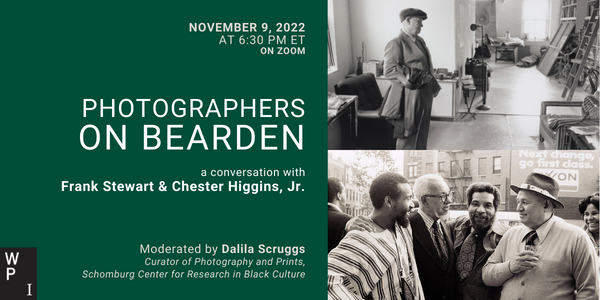
Webinar: Photographers on Bearden on 11/9

Photographers on Bearden: a conversation with Frank Stewart and Chester Higgins Jr. 

Wednesday, November 9, 2022 at 6:30 pm ET on Zoom 

Register here

Join renowned photographers Frank Stewart and Chester Higgins, Jr., in a conversation moderated by Dalila Scruggs, Curator of Photography and Prints at the Schomburg Center for Research in Black Culture, who will discuss their relationship with the acclaimed African-American artist, Romare Bearden, and their experiences photographing African-American artists and culture over the years. 

This event celebrates the initial release of the Romare Bearden Papers by the Wildenstein Plattner Institute (WPI). The WPI has worked closely with the Romare Bearden Foundation to make the artist’s archival collection accessible to the public in anticipation of the forthcoming Romare Bearden Digital Catalogue Raisonné

The Romare Bearden Papers are accessible to the public on the WPI’s Digital Archives

Frank Stewart shot his first photographs at the 1963 March on Washington and has gone on to make compelling images ever since. Stewart earned a BFA in photography from Cooper Union in 1975 and counts Roy DeCarava, Garry Winogrand, Jack Whitten, and Romare Bearden amongst his mentors. Stewart was the first photographer-in-residence at The Studio Museum in Harlem, where he also taught photography. He has been a member of Kamoinge, Inc. since 1982, and was the lead photographer for Jazz at Lincoln Center almost three decades. Stewart is widely published, has had more than thirty solo exhibitions and is the recipient of numerous prestigious awards. His work is held in the collections of major museums including Bowdoin College Art Museum, Brunswick, Maine, the Detroit Institute of Arts; George Eastman House, Rochester, New York, the High Museum of Art, Atlanta, the Museum of Modern Art, New York, the National Museum of African American Art and Culture, Washington, DC, and the Studio Museum in Harlem, New York. Stewart is the subject of an upcoming retrospective titled, Nexus: An American Photographer’s Journey, 1960’s to the Present, that opens at the Phillips Collection in Washington, DC, in June 2023.

Chester Higgins Jr. is a photographer known for his eloquent images of the life and culture of African Americans and the people of the African Diaspora. He counts P. H. Polk, Arthur Rothstein, Cornell Capa, Gordon Parks and Romare Bearden amongst his mentors. He was a staff photographer for the New York Times from 1975 to 2014. Widely published, his photographs have appeared in magazines including Ebony, Essence, Fortune, LIFE, Look, Newsweek, and TIME, and in several books including Sacred Nile, Echo of the Spirit and Elder Grace. His work has appeared in numerous solo exhibitions, most recently The Indelible Spirit at the Bruce Silverstein Gallery. He has received fellowships and grants  from the International Center of Photography, The Ford Foundation, The National Endowment for the Arts and the Rockefeller Foundation. His photographs are included in the following permanent collections: The Museum of Modern Art, New York, the Museum of Modern Art, San Francisco, the Virginia Museum of Fine Art, Richmond, the Library of Congress, and the Schomburg Center for Research in Black Culture, New York.

Dalila Scruggs is Curator for Photography and Prints at the Schomburg Center for Research in Black Culture. She earned a Ph.D. in Art History from Harvard University, where she focused on African American art. She has held curatorial positions at the Williams College Museum of Art and the Brooklyn Museum, and served as the Brooklyn Museum’s Museum Education Fellowship Coordinator.


The Wildenstein Plattner Institute, Inc. (WPI) is a non-profit foundation dedicated to the study of art history and to fostering the accessibility, cataloguing, and digitization of archival materials that support critical research in the field.