The Dark Room is coming…to Wellesley College on Saturday, April 11

nikkigphd's avatarNikki G Ph.D.

Third Exposure SymposiumTHIRD EXPOSURE~THE DARK ROOM: RACE & VISUAL 3RD ANNUAL SYMPOSIUM on Saturday, April 11 at Wellesley College. Free and Open to the Public. See below for the full schedule.

The Dark Room: Race and Visual Culture Studies Seminar is an extended conversation concerning the intersection of critical race theory and visual culture studies. With over 40 members from 24 North American colleges and universities, we are a group of regional and institutional variety, made up of several different disciplines and departments and different professional ranks. We meet once a month during the academic year to consider the import of recent published works heavily invested in the interstices of visualities rendered through the lens of race and empire. Third Exposure is just that, our third foray into a collective intellectual engagement of this kind. #3rdExp

Email: raceandvisualcultureseminar@gmail.com | Twitter: @raceandvisual

Program Schedule

8:30      Registration    Collins Cinema

9:00     

View original post 598 more words
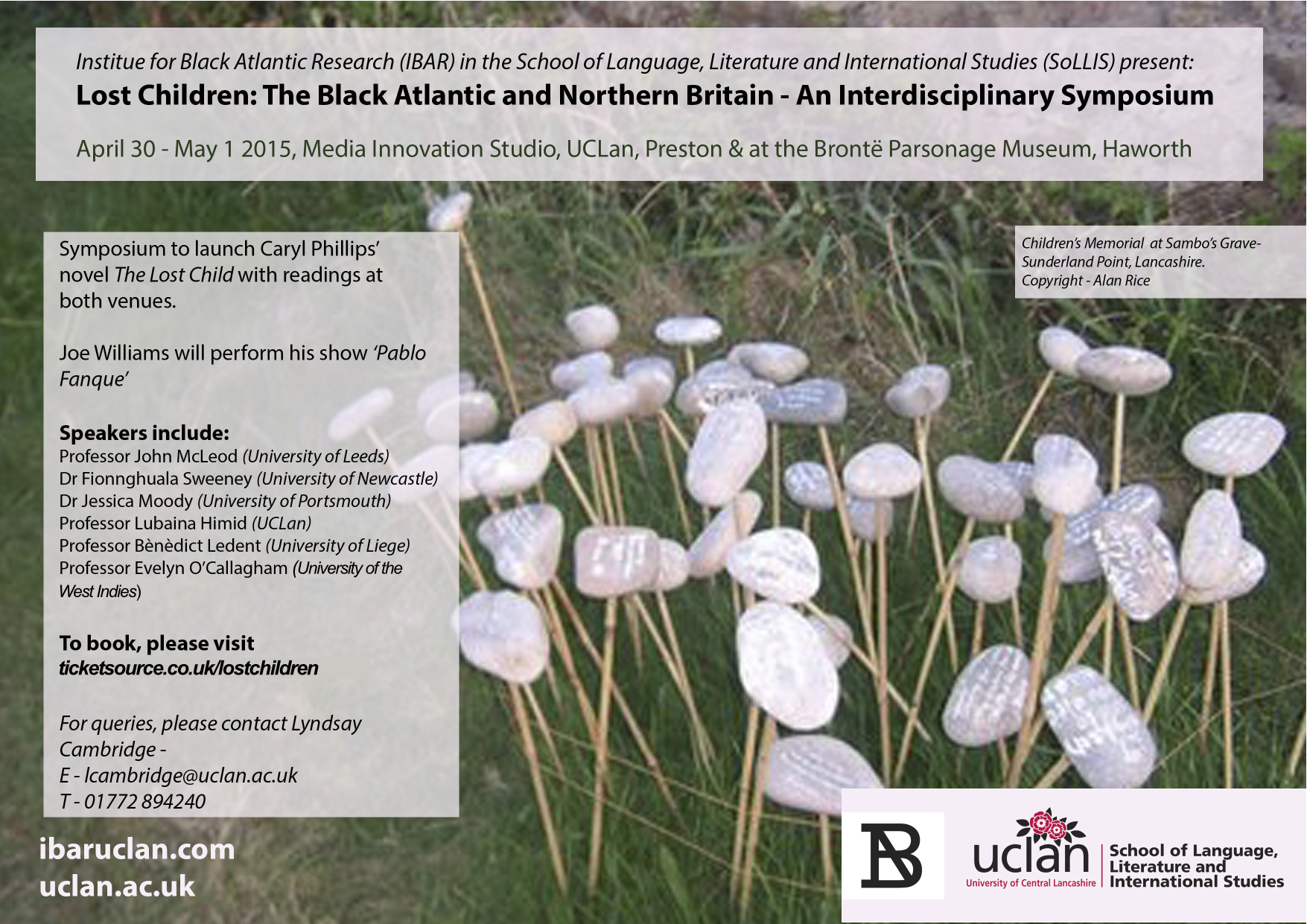
“The Black Atlantic and Northern Britain” – a symposium (Apr. 30-May 1, 2015)

IBAR - Lost Children copyMore info at:

http://ibaruclan.com/ibar-in-association-with-the-bronte-parsonage-museum-haworth-present-lost-children-the-black-atlantic-and-northern-britain-an-interdisciplinary-symposium-april-30-may-1/

Shulman And Bullard Article Prize — Deadline Apr. 15, 2015

http://printscholars.org/article-prize/

SO! Amplifies: Mendi+Keith Obadike and Sounding Race in America

guestlistener's avatarSounding Out!

Document3SO! Amplifies. . .a highly-curated, rolling mini-post series by which we editors hip you to cultural makers and organizations doing work we really really dig.  You’re welcome!

Several years ago—after working on media art, myths, songs about invisible networks and imaginary places—we started a series of sound art projects about America. In making these public sound artworks about our country we ask ourselves questions about funk, austerity, debt and responsibility, aesthetics, and inheritance. We also attempt to reckon with data, that which orders so much of our lives with its presence or absence.

We are interested in how data might be understood differently once sonified or made musical. We want to explore what kinds of codes are embedded in the architecture of American culture.

Big House/Disclosure

image02

The first sound art project in this vein that we completed in 2007 was entitled Big House / Disclosure. Northwestern University commissioned

View original post 866 more words

http://centerforartandthought.org/news/call-submissions-cats-virtual-exhibition-racecraft

To Collect—Essentially

This article dates to August 2014, but its concerns remain current and pressing: what do the ways in which we “collect” and “conserve” the past reveal about what we want from it?

Melissa Eddy, “Lost in Translation: Germany’s Fascination with the American Old West”

http://http://www.nytimes.com/2014/08/18/world/europe/germanys-fascination-with-american-old-west-native-american-scalps-human-remains.html?module=Search&mabReward=relbias%3Ar%2C%7B%222%22%3A%22RI%3A16%22%2C%221%22%3A%22RI%3A11%22%7D

Visualizing Race, Ethnicity, and Nation in New Zealand

This article swings at and misses its targets; the journalist wants to express his admiration for what he reads as diversity and multicultural identity in New Zealand. But he fails to get out of the gate cleanly; he does not line up key terms to ensure that he and readers are on the same page when, for instance, “race” is evoked. For that reason, the absence of interrogation into historical relationships in the country is not surprising. One can only wish for a consideration of the Wellington (or Auckland) Street in this article. . . I guess the posted comments are telling.

There is something going on with haka performances. What do those who perform haka think they’re doing? What do various audiences see when they watch haka dances? Are they watching masquerade? Watching the visualization of a national anthem as movement and chanting? Is there a collective experience?

http://www.theguardian.com/world/2014/oct/13/-sp-new-zealand-teach-us-race-sport-ceremonies-legal-treaties#comments

National Gallery West Premieres ‘The Price of Memory’ in Montego Bay

nationalgalleryofjamaica's avatarNational Gallery of Jamaica

Price of Memory flyer - smaller

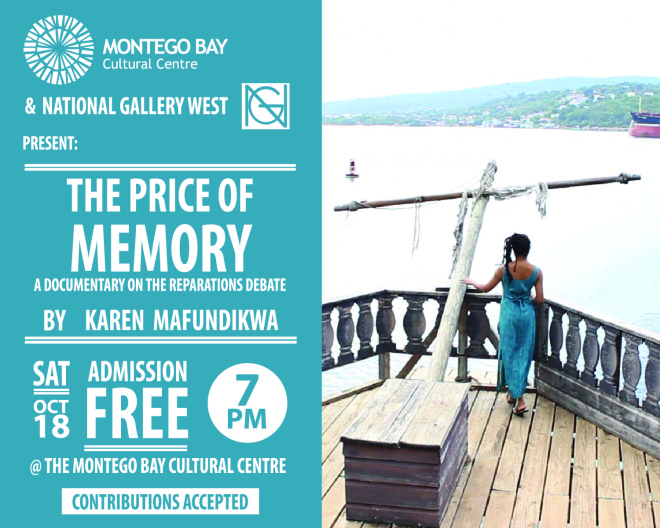
The Montego Bay Cultural Centre and National Gallery West are pleased to present the Montego Bay premiere of the documentary ‘The Price of Memory,’ a documentary film by Karen Marks Mafundikwa, on Saturday, October 18, starting at 7 pm, at the Montego Bay Cultural Centre, Sam Sharpe Square. The film maker will be in attendance to introduce the film and to answer questions afterwards. Admission will be free but donations in support of the Montego Bay Cultural Centre programmes will be gratefully accepted.

Filmed over the span of eleven years, ‘The Price of Memory’ explores the legacy of slavery in the UK and Jamaica and the initiatives and debates surrounding reparations. The film starts in 2002, with Queen Elizabeth II’s visit to Jamaica as part of her Golden Jubilee celebrations, when she is petitioned by a small group of Rastafari for slavery reparations. The film traces this petition and the…

View original post 231 more words

ARTICLES: Material Cultures of Slavery in British Caribbean

Jessica Marie Johnson's avatar#ADPhD

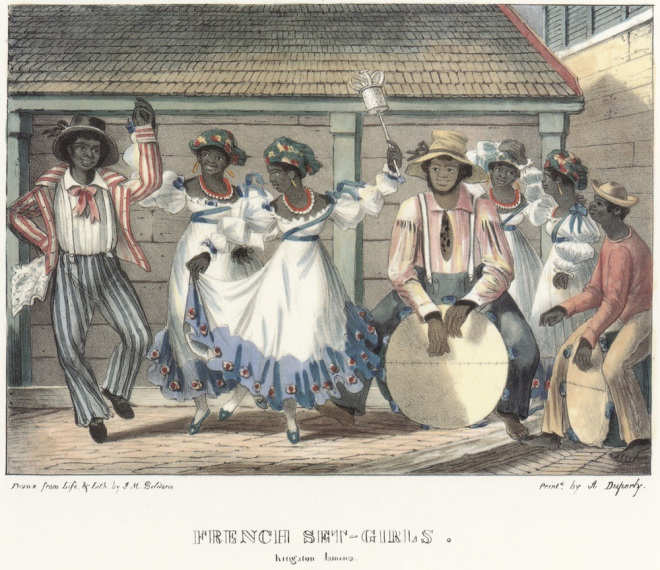
“French Set-Girls,” in  Isaac Mendes Belisario, Sketches of character, in illustration of the habits, occupation, and costume of the Negro population, in the island of Jamaica: drawn after nature, and in lithography (Kingston, Jamaica: published by the artist, at his residence, 1837-1838). http://hitchcock.itc.virginia.edu/Slavery/detailsKeyword.php?keyword=jamaica&recordCount=100&theRecord=1

Special Issue: Material Cultures of Slavery and Abolition in the British Caribbean

Edited by Christer Petley and Stephan Lenik

Stephan Lenik and Christer Petley, ‘Introduction: The Material Cultures of Slavery and Abolition in the British Caribbean’

Section I – Planters, workers and the development of plantation space

1. Douglas V. Armstrong and Matthew C. Reilly, ‘The Archaeology of Settler Farms and Early Plantation Life in Seventeenth-Century Barbados’

2. Stephanie Bergman and Frederick H. Smith, ‘Blurring Disciplinary Boundaries: The Material Culture of Improvement during the Age of Abolition in Barbados’

3. Christer Petley, ‘Plantations and Homes: The Material Culture of the Early Nineteenth-Century Jamaican Elite’

Section II – Material inequalities and practices inside enslaved communities

4. Justin Roberts, ‘The “Better Sort” and the “Poorer Sort”: Wealth Inequalities, Family Formation and the Economy of Energy on British Caribbean Sugar Plantations, 1750-1800’

5. James A. Delle and Kristen R. Fellows, ‘Death and Burial…

View original post 134 more words

The Ku Klux Klan’s Images of Race, circa 2014

Yesterday’s New York Times included a story, “At Gateway to Hamptons, Ku Klux Klan Advertises for New Members,” by Al Baker. Here’s a link to Baker’s story, which rightly focuses on the undeniably anti-immigrant impetus behind contemporary flyers and pamphlets produced by the Klan:

http://www.nytimes.com/2014/08/30/nyregion/at-gateway-to-hamptons-ku-klux-klan-advertises-for-new-members.html?_r=0

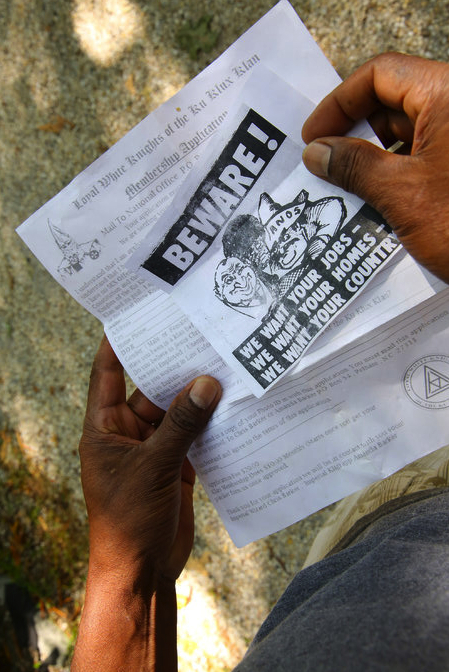
I want to draw attention to one of the images that accompanied Baker’s story: Times photographer Nicole Bengiveno’s photo poignantly captures a pair of brown-skinned hands holding the Klan recruitment letter and hate-mongering caricatures. What’s striking is the Klan’s reliance on undying, racist iconography, which communicates the group’s belief that it’s still legible and viable in the twenty-first century:

KKK NY_Beware 2014

That visual strategies–exaggerations and distortions of ethno-cultural physiognomies and the marshaling of symbols attached to class and national types–still work in nativist discourse makes clear that racialization is always dependent on representation.